
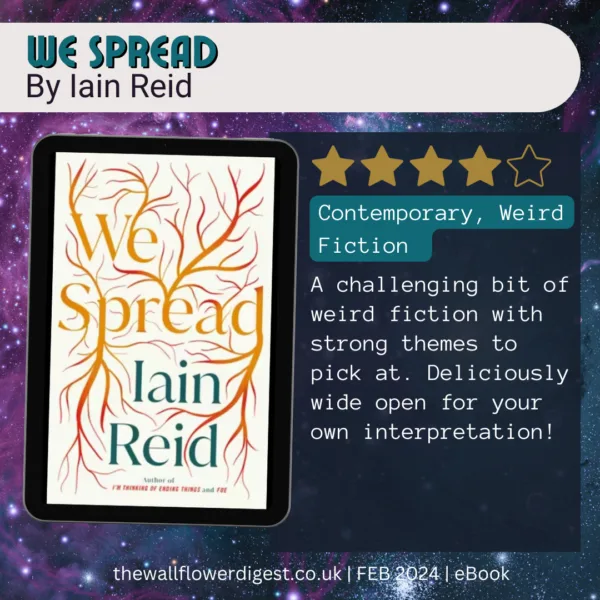
⭐⭐⭐⭐ 4/5 Stars – A challenging bit of weird fiction with strong themes. Deliciously wide open for your own interpretation!
Format: Kindle
Read: Feb 2024
I finished reading We Spread a month ago and I’ve sat on this review because I couldn’t decide what to do about it. This is a positive because it means the book is great and there would be lots to talk about, but I’ve had a hard time trying to articulate my thoughts on it. Really, I think it would benefit from a second read but I didn’t quite love it enough to devote time to starting it again quite yet. Perhaps one day I might come back to it for a more complete analysis but for now I’ll share a scattering of my thoughts and some discussions I’ve found online.
I have never read anything by Iain Reid before, nor had I heard of him. I was drawn to We Spread simply because it was 99p on a Kindle deal and it had this quote from Mona Awad on the cover.
‘I loved this book and couldn’t put it down – a deeply gripping, surreal and wonderfully mysterious novel. Not only has Reid given us a brilliant page turner, but a profoundly moving meditation on life and art, death and infinity. Reid is a master’
Mona Awad, author 13 Ways of Looking at a Fat Girl and All’s Well
This succinct little summary (she’s so good at that) highlights things I love in her work, and I would very much like to find mother authors who write this kind of book (I will take recs in the comments)! I’ve been around the block enough to take quotes from other authors on the cover of books with a huge pinch of salt, but in that case, I absolutely agree. This book is all those things!
Summary
The story centres on the lonely, elderly Penny who finds herself admitted to an unusual retirement home after she suffers a fall changing a lightbulb in her apartment. At first, she enjoys the comforts of the small community but as she suffers unexplained slips in memory she begins to feel that something is very wrong at Six Cedars.
The story is told in an immediate first-person perspective and short sections which give it a real sense of unsettled urgency and made it highly bingeable. Neither Penny nor the reader can get a grip on what’s happening before another skip in time with lost memory. Like Penny, the reader is always disorientated.
I can’t think of another book I have read with a protagonist in this age bracket. It was a refreshing change in perspective, but also quite challenging as it made me think about the struggles of my own grandparents (and also the future for my parents, and myself).
Penny is on her own, which is how she ends up in the retirement home. She never had children and lived alone after her partner died, and she lives an isolated life as so many elderly people now do. I think most of us carry feelings of guilt and shame over how the elderly are treated and cared for, and often the responsibility is handed to strangers (like Shelley and Jack). It’s difficult to be confronted with such a raw depiction of Penny’s experience.
Getting old is terrifying.
But what is actually happening!?
If you are the type of reader who likes a clean-cut ending then this will not be the book for you! With this one, the ambiguity is the point, and I personally enjoy this type of open to interpretation ending, when its been well crafted. It is backed up with strong themes (aging, creativity and purpose, zero and infinity, community) and recurring motifs that do make this novel very fun to pick at. It absolutely can be read in several different ways and it’s entirely open for the reader to decide how much of the novel was real.
At the heart of the whole novel is Penny, and she is an unreliable narrator. She might have been suffering dementia and it was all within her own mind, or there were sinister experiments being done to her. Or both.
I actually think both is the scarier version for me. Both things being true means we have an extra evil taking advantage of vulnerable, while pretending empathy.
This bit will discuss general plot details but no specific spoilers, skip past if you don’t want to know anything!
My personal interpretation is that it was a combination of Penny’s deteriorating mind and some weird shit really was happening. After all, she was leaving the post-it notes for herself before she went to Six Cedars. She was already hearing voices, and losing track of time. On the other hand, there were a lot of odd things about the home that don’t feel specifically connected to Penny – only 4 residents and none of them had people to check in on them; they all had a special talent (each about making connections – painting, languages, music and maths); the conversation overheard between Shelley (a clear Frankenstein reference!) and an unfamiliar male; and of course the many references to the Pando tree that give the novel it’s title (Latin for “I spread”).
Some other readers in this fascinating Reddit thread had some very interesting ideas (I never think to go for Reddit for literary discussion but I guess I should!):
- It all happened within her own imagine as she lay dying after the fall at the start of the book.
- User BigFella_47 pointed out the significance of Penny’s name being 1 in 100. She was also 1 out of the 6 people at the home, which is 0.16. I love stuff like this!
- User mosh32 has a left of field theory that everyone was just a painting!
- I love RealisticJudgment944’s idea that interpretation is likely to be different depending on the age of the reader and their feelings about growing old.
- User DavidEden9 views the reading experience as a simulation of how it can feel to have dementia and your own mind betraying you.
- User TortoiseWayfarer did two readings and has convincing arguments that it is the perspective of something with mid-level Alzheimer’s and nothing sinister was happening.
Reading other people’s idea on this did get my hyped again for doing my own analysis, but I just don’t have the time/bandwidth right now. Perhaps one day I will come back to this one!
Iain Reid is now on my radar!
I don’t think this is a 5 star book, as much as it got my juices flowing it has left me with a sense that something wasn’t quite finished about it. I don’t know what that thing is but something felt missing for it to be truly satisfying. However, it absolutely has put this author on my radar! I will be on the look out for Foe and I’m Thinking Of Ending Things (I’ve seen that there is an adaption for this on Netflix, but not watched it.).
If you like weird fiction, if you like unreliable narrators and ambiguity and picking over a book to find your own interpretation you will probably love this! If you like the work of Mona Awad you will probably love this.
If you do not like those things, if you need a clear cut ending that gives you all the answers, then steer clear of this one!
If you’ve read it, I’d love to discuss!
REVIEW SUMMARY
I LIKED
- The reader is completely along for the ride with Penny, with all her disorientation, confusion and paranoia. Engrossing, urgent reading.
- Refreshing (and challenging) to have the perspective of an elderly protagonist.
- Strong themes and motifs to play with for each reader to find their own interpretation.
I DIDN’T LIKE
- It did feel a little bit unfinished somehow. I can’t put my finger on it but it didn’t leave me with 5 stars excitement!