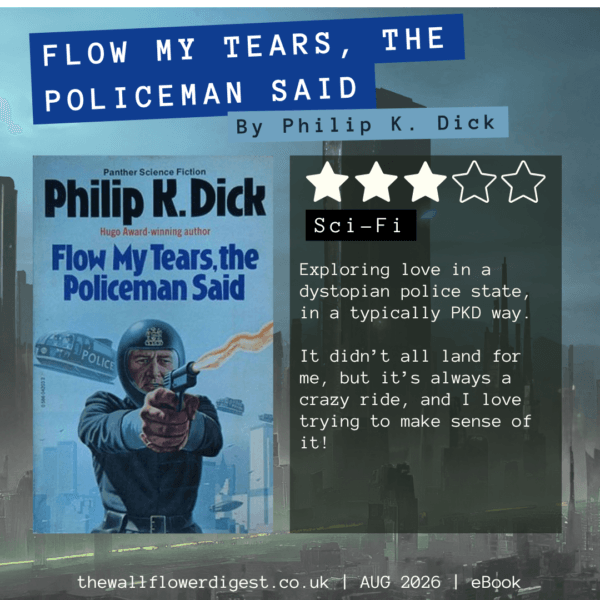
⭐⭐⭐ 3/5 Stars – Exploring love in a dystopic police state, in a very PKD way.
Format: eBook
Read: August 2026
This is my fourth PKD in a row. Written in 1970, it wasn’t published until 1974, and from doing a little bit of research after finishing the novel turns out it was one of his novels he was most proud of, but also had an interesting road to publication (and there are sort of two editions of it thanks to a miscommunication with the French first edition) that makes me wish I’d read his biography (one day, maybe next year).
By now I’m noticing a pattern in the exploration of themes that interest him, and the types of characters he chooses to work with. Every book I’ve read so far has taken place in a short time frame – a single day or a few days (even if there were time skips as in Dr Bloodmoney) – and has followed a bloke just trying to live his life when something weird happens that upends his sense of reality.
This is essentially also true of Flow My Tears, although the main protagonist Jason Taverner is not the typical Dick everyman. Taverner is an extremely famous TV personality and singer, very proud of his 30 million-strong viewership. He’s a rare genetically enhanced human (a ‘six’), so he really does see himself as superior to the rest of the human race. His wonderful life is upended when he wakes up in a down-and-out motel with no ID cards and nobody having any memory or records of his existence. This version of 1988 America is a police state, and not being in the system is a huge problem that could get you, at best, sent to a forced labour camp, and at worst, killed.
Once again PKD manages to fold in some deep philosophical musings on what it means to be human and dystopian world details that feel eerily prophetic (did he predict internet porn?), all into another wacky sci-fi story that is under 250 pages. This is my least favourite, I think, of the 4 I’ve read this year, but also I suspect I might love it more on a re-read because – as with Ubik – where we end up is not where I expected to go when we started (you’d think I’d learn by now)!
As usual, I’m going to have a think on the themes and what I think PKD was saying with this novel, so spoilers ahoy!
🚨🚨🚨 SPOILERS AHEAD 🚨🚨🚨
Police State
The student enemy
This is a version of America where students are essentially imprisoned in underground bunkers on University campuses, and those that escape and are caught are sent to forced labour camps. Exactly why this is the case doesn’t matter. I would guess that Dick was inspired by the 1970s student protests over the Vietnam War, but even without that, there has been a trend in right-wing American politics of blaming universities for breeding ‘liberalism’ and ‘socialists’ since William F. Buckley in the 1950s. This is something still in the US Conservative playbook to this day (arguably back and bigger than ever), and so still exists a cultural shorthand that allows this detail of the world to make sense even without explanation (and thanks to inescapable cultural osmosis make sense to me as a Brit without needing to research!).
Surveilance
Once they notice you, Jason realized, they never completely close the file. You can never get back your anonymity. It is vital not to be noticed in the first place. But I have been.
When Jason wakes up and realises he has no ID he quickly sets about problem solving – because as a guy with 5K in his pocket there are never problems that can’t be solved – and asks the hotel clerk for help getting a fake ID so he doesn’t end up in a labour camp before he can work out whats going on.
He is taken to a young woman called Kathy Nelson, who turns out to be manically (disturbingly) mentally ill and a police informant (as is the clerk). She has been working as a police informant (is that ever be voluntary?) because she believes it will get her husband early release from a forced labour camp.
Later, when we meet Detective McNulty we find out her husband died in a vehicle accident three years ago, and the police have been manipulating her to take advantage of her delusions. Is it better that she knows and lives with the grief of the loss and knowledge of the damage she did to others; or that she keeps living with small hope of his release but continues to compromise her morals?
We have a betrayal state, he realized. When I was a celebrity I was exempt. Now I’m like everyone else: I now have to face what they’ve always faced. And–what I faced in the old days, faced and then later on repressed from my memory. Because it was too distressing to believe . . . once I had a choice, and could choose not to believe.
Who defines morality?
The other major character is General Felix Buckman, a high-ranking police chief who becomes interested in Jason Taverner’s case – a man who comes to their attention because he was trying to get onto the grid.
Buckman is an interesting contradiction. He listens to cultured classical music; he has antiquarian hobbies collecting stamps and artefacts from past civilisations, which are obtained through dodgy contacts. He is also sympathetic to students and holds contempt for colleagues who escalate violence for their perverse enjoyment. He also clings to more traditional moral values in a world that has embraced taboo, despite harbouring his own secrets
He has a twin sister, Alys, an unstable and chaotic character whom he allows to hang around his office. The two have an incestuous relationship which produced a secret child. He fears and hates Alys as much as he loves her. Alys also doesn’t seem happy about their situation, and in contrast to her otherwise painfully upright twin, lives a hedonistic life of drugs and sex.
“Nothing scares you,” he said, accusingly. “Since your brain operation. You systematically, deliberately, had all your human centers removed. You’re now a”–he struggled to find the words; Alys always hamstrung him like this, even managed to abolish his ability to use words–“you,” he said chokingly, “are a reflex machine that diddles itself endlessly like a rat in an experiment. You’re wired into the pleasure nodule of your brain and you push the switch five thousand times an hour every day of your life when you’re not sleeping. It’s a mystery to me why you bother to sleep; why not diddle yourself a full twenty-four hours a day?”
I did find the incest shocking and confusing, partially given the antagonism in their relationship, but it is part of a larger picture of PKD pushing societal taboos. There is a chapter in which the police, while looking for Jason, break into an apartment and find a middle-aged man in bed with a 13-year-old boy. The officers are revolted by this but can’t do anything because the age of consent has been lowered to 12, part of an initiative to decriminalise “victimless crimes.”
“Probably,” Mufi said, with confidence now that the pols were beginning to depart from his bedroom, “because some of those big overweight old police marshals are screwing kids themselves and don’t want to get sent up. They couldn’t stand the scandal.” His grin grew into an insinuating leer.
This world is one where the powerful have laws allowing for their perversions. The Buckmans’ consensual adult incest is more scandalous than grown men “screwing kids” because (as long as they’re 12) that’s legal, and it threatens to unravel his career and, as such, is the impetus for him framing Jason for Alys’ murder, when he knows it was an accident.
Those at the top don’t face consequences
Jason goes on this multi-day journey and ultimately he learns nothing. For a start, he might have lost his celebrity, but he still has 5K in his pocket, and money will get you anywhere no matter who you are. He also has the magnetic power of being incredibly attractive, so people naturally respond to him favourably (this might also be part of his genetic enhancement that he secretes something). For Jason, he never really doubts that everything will work out – because that has been his lived experience.
In the epilogue we learn that thanks to his mega fame and wealth he is miraculously able to beat the false murder charges and still be a celebrity, even increasing his viewership.
Love
Given what I have described above, this might be a surprising turn of theme. I confess it took me by surprise, as did the emergent Christian themes in Ubik! Then I realise that this snippet was included within the first few pages, and an indictment of Jason’s character and the society he’s a mega celebrity in.
“I zip up my fly every week,” Jason said. “It’s my trademark. Or don’t you catch the show?”
Dick is most explicit with this through the character of Ruth Rae, but each of the series of women that Jason meets represents something. None of them are fully fleshed characters. They enter the stage to demonstrate a facet of this theme, and then are not heard from again – this is usually the case in Dick’s novels; he’s more interested in his ideas than his characters – but I think it also seems to fit with the way Jason as a character moves through the world in general.
Love is intimacy
The first is Heather Hart, a fellow six and celebrity singer who hates her own adoring fans. She’s essentially his girlfriend, apparently the one who knows him best and the only person he views as an equal; however, she seems exasperated by his womanising and lack of commitment. In the first chapter, where we meet Heather, they have to divert their ride home together from his show to deal with a phone call from Marilyn Mason, an aspiring actress he’d been sleeping with.
Jason periodically misses Heather and wishes he could talk with her; she is the person closest to him in the world.
Love (or sex) as a transaction
Jason sees all relationships as transactions (except perhaps less so with Heather), but his relationship with Marilyn typifies this – they had a brief affair, and he got her audition. He doesn’t understand why she’s upset to hear from him in six months because he upheld his end of the deal. She throws some sort of parasite creature (a ‘Callisto cuddle sponge with its fifty feeding tubes’ – excellent) at him, and he would have died if he’d not been rescued by Heather.
“Responsibility,” he said, “for the consequences to others of your acts. You’re morally, ethically drifting. Hitting out here and there, then submerging again. As if nothing happened. Leaving it to everyone else to pick up the sweltering moons.”
(Jason to Kathy)
Self-centred love
The next woman is Kathy the forger, another young girl (it just occurred to me that if she is 19, as she says, and her husband died 3 years ago, she was at most 16 when they married). Her love for her husband is her justification for her illegal activities and informing on her clients to the police, and yet she is attracted to Jason and begs and tries to manipulate him into sleeping with her. She admits to sleeping with other men she’d been attracted to, and through her self-centred, mentally ill worldview, can spin this to herself so it is not betrayal – nothing is ever her fault; it’s not her choice, it’s destined. Her manic, emotional whirlwind threatens to drag Jason in (especially as he needs the ID from her for his survival), but she doesn’t get her way; she has a dramatic public tantrum.
Love and loss
Then we have Ruth Rae, one of Jason’s ex-mistresses, but in this reality she has no memory of him. Ruth is 39 (/s so old and withered), has been married 21 times and has had countless lovers. For her, sex and love are conflated. Her age and experience turn Jason off; he’s not attracted to her even though they have sex and he does describe her as good in bed. Somehow, a woman they both know – Monic Buff – who never bathed or washed her hair, was, by comparison, more attractive in Jason’s memory than this 39-year-old withered crone.
Then this exchange happens, which I’m sharing because… it’s bizarre and brilliant.
“I can’t stay,” he said, “any longer. And anyhow, you’re too old.”
She stared at him, ludicrously, like a warped, stomped doll. And then she ran off into the kitchen. Why did I say that? he asked himself. The pressure; my fears. He started after her.
In the kitchen doorway Ruth appeared, holding up a stoneware platter marked SOUVENIR OF KNOITS BERRY FARM. She ran blindly at him and brought it down on his head, her mouth twisting like newborn things just now alive. At that last instant he managed to lift his left elbow and take the blow there; the stoneware platter broke into three jagged pieces, and, down his elbow, blood spurted. He gazed at the blood, the shattered pieces of platter on the carpet, then at her.
“I’m sorry,” she said, whispering it faintly. Barely forming the words. The newborn snakes twisted continually, in apology.
Jason said, “I’m sorry.”
“I’ll put a Band-Aid on it.” She started for the bathroom. “No,” he said, “I’m leaving. It’s a clean cut; it won’t get infected.”
“Why did you say that to me?” Ruth said hoarsely.
“Because,” he said, “of my own fears of age. Because they’re wearing me down, what’s left of me. I virtually have no energy left. Even for an orgasm.”
“You did really well.”
I am offended as a 38-year-old woman, and I also sort of love Ruth.
Anyway, after this, Ruth and Jason have a heart-to-heart where she explains to him about the relationship between love and grief, which explains how she has been married 21 times. She tells him a parable about Emily Fusselman’s rabbit who wanted to be a cat and got bitten by a dog, which is extraordinary, and about the death of her own dog. Earlier in the book, Kathy and Jason briefly discuss “Dinman’s philosophy” that owning a cat increases a person’s empathetic ability, and of course this is a huge component of Mercerism in Do Android’s Dream of Electric Sheep?
Grief causes you to leave yourself. You step outside your narrow little pelt. And you can’t feel grief unless you’ve had love before it–grief is the final outcome of love, because it’s love lost. You do understand; I know you do. But you just don’t want to think about it. It’s the cycle of love completed: to love, to lose, to feel grief, to leave, and then to love again. Jason, grief is awareness that you will have to be alone, and there is nothing beyond that because being alone is the ultimate final destiny of each individual living creature. That’s what death is, the great loneliness
Jason doesn’t really understand what Ruth is saying; he doesn’t see how pain can be a good thing.
Hedonistic love
Next, he encounters Alys, who is interested in him because she actually does know who he is and possibly understands that it was she who brought him out of his reality and into hers through her use of the drug. If Ruth is sex and love, Alys is a pure hedonist, and sex is just another avenue – along with large amounts of drugs – to personal gratification. She sleeps with men (including her twin), women (including Heather Hart), wears fetish gear and has orgies, and is addicted to the “phone grid” which seems to be pretty close to internet porn – a network that people join and have simultaneous orgasms.
“Your–everybody’s–sexual aspects are linked electronically, and amplified, to as much as you can endure. It’s addictive, because it’s electronically enhanced. People, some of them, get so deep into it they can’t pull out; their whole lives revolve around the weekly–or, hell, even daily!–setting up of the network of phone lines. It’s regular picturephones, which you activate by credit card, so it’s free at the time you do it; the sponsors bill you once a month and if you don’t pay they cut your phone out of the grid.”
Alys’ obsessive pursuit of pleasure does lead to her early death, and we also hear that addiction to the phone grid is common and leads to people being isolated and living unhealthy lives. In the epilogue, we hear that Ruth also had been a user of this network, and it played a part in her mental state and her death (after husband 51).
Contented, authentic love
The final woman is Mary Anne, a timid and anxious young woman who makes beautiful pottery. She helps Jason right at the end as the world remembers who he is again, his fame returning, but she doesn’t want anything from him; all she wants is to help him and get back to her quiet little life where she makes her art. Jason carelessly breaks her prize vase, which he pays for, and she gives him another one. I’m sure there is some significance to the vases being blue, but I couldn’t nail it.
The blue vase made by Mary Anne Dominic and purchased by Jason Taverner as a gift for Heather Hart wound up in a private collection of modern pottery. It remains there to this day, and is much treasured. And, in fact, by a number of people who know ceramics, openly and genuinely cherished. And loved.
There is a simple authenticity to both Mary Anne and her pottery, which she sincerely believes in and makes for her love of it and for a small audience that appreciates it. She was never interested in Jason’s offer to be on his show and launch her business to millions. In the epilogue, we learn that while Jason’s death in his old age went largely unnoticed, her blue vase is treasured by collectors and admirers of ceramic art. Her use of her talents for the love of the art, and not for fame and fortune, ultimately outlasts Jason’s.
Simple human kindness
The ultimate climactic moment of the novel is when Felix Buckman, driving out of his mind with grief over losing Alys, is flying around in his car crying (tears flowing, if you will) but then spots an elderly black man is filling his car at a gas station. He gives the man a scribbled note with a doodle of an arrow piercing a heart, returns to his car, then gets out again and hugs the stranger. The man is kind to him, and they exchange pleasantries before parting ways. This simple act of non-sexual, non-transactional love and kindness to a stranger brings Felix back into himself, and he resolves to fetch his son and make a new life for them away from this place.
I think also of note is that there was another ‘elderly black man’ earlier in the novel, which prompted Jason’s conversation with the hotel clerk, with a rare bit of world-building informing us that this world is one where black people have many protective rights from violence against them, but they are only permitted to have one child in an effort to reduce the population. It is worth remembering again that this book was written in the 1970s, which I understand was when the Civil Rights Movement was gaining ground in the USA. We also learned that Jason admires this policy, which is absolutely racist and his attitude is never challenged or changes, just as we learn in the epilogue that once he got his privileged life back, he lives no differently than he did before.
Conclusions
Of the 4 novels I’ve read this year, I think this ranks bottom. While I did enjoy pulling out these themes, I’m not sure it was as successful as some of the other books. While the plot and story are great, I found Jason quite tiresome and some of what I think PKD wanted to say was either too oblique or clunky. The resolution to the plot- what happened to Jason and Alys’ deaths is the most confusing nonsense I’ve read so far! It’s pure hand-waving, though I did get a kick out of Felix repeating that he was leaving and couldn’t be arsed to try to understand what the coroner was explaining about the time/space/reality bending drug Alys took that somehow pulled Jason out of reality. In a way – same, like I don’t really care how that drug works and it was annoying to read – but also it wasn’t a satisfying conclusion to that mystery. It was also never returned to or explained what happened at the start when Marylin threw the paracise on him – I think he was fine after that, and it was a coincidence that Alys took the drug at the same time and it was a red herring?
The climactic scene at the gas station also didn’t really land for me because it felt so out of the blue. I didn’t understand Felix and Alys’ relationship – even twincest aside – it was a complicated mess of antagonism, and she was so barely sketched that it was never really explored, so the emotional impact of her loss was something I wasn’t feeling as a reader.
But, I think, like all PKD fans, I can see the flaws in his work while also being awstruck by how he manages to pack in so much Big Stuff into such short and rushed novels. His characters are just paper dolls he uses to explore his ideas. I’ve started to picture his novels as something temporary he conjures up onto a homemade cardboard stage because he wants to talk to me about something existential and deeply human, and he’s going to do it in a fun and funny sci-fi way. Somehow, despite the fact that I am a character-driven reader, I love him because I find his ideas and the way he wrote them so fucking fascinating.
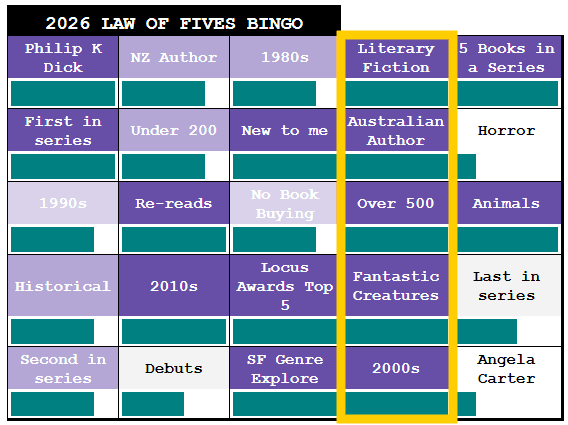
For Law of Fives, this was my 4th Dick! One more to go, and that one will be The Three Stigmata of Palmer Eldrich.
REVIEW SUMMARY
I LIKED
- Fun premise.
- I never knew where it was going to go next! (It shocked me a few times!)
- Off-kilter – very Dickian – exploration of themes.
I DIDN’T LIKE
- I didn’t find it entirely coherent.
- Found the climactic scene more clunky than moving.