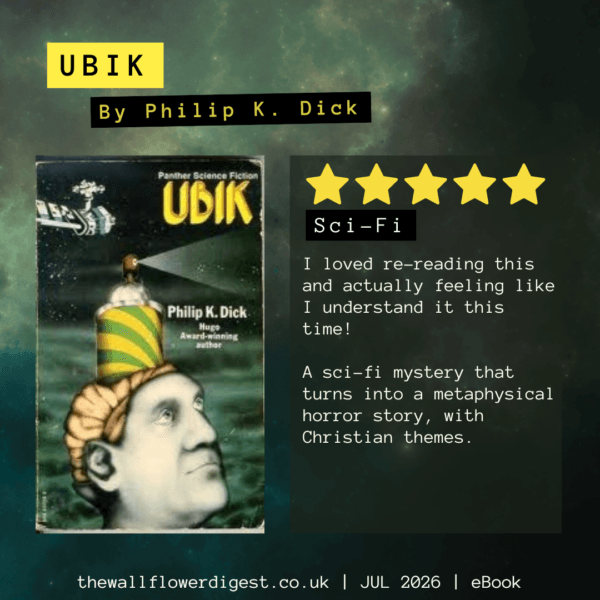
🌟🌟🌟🌟🌟 5/5 – I really enjoyed my re-read, and I think I finally get it!
Format: eBook
Read: July 2026
I first read Ubik in 2018, and while I really enjoyed it, I knew at the time I didn’t get it; I didn’t really understand a) what had really happened plotwise and b) what it all meant! It was a book begging for a re-read, and the time was finally right.
This was my third PKD read in a row, and armed with my improving close reading skills and having finally figured out how to keep a reading log, I was determined to make sense of things this time around!
Ubik is an incredibly disorientating novel in which neither the reader nor the characters can ever be sure what is going on! It starts as a science-fiction mystery with psychics and ends up a metaphysical horror story. It’s Dick, so it’s weird, and it’s funny and satirical, and the overall wackiness covers a lot of deeply philosophical ideas. Of all the books I’ve read so far, this one definitely has the most packed plot and moves extremely quickly, but that’s all in service of keeping the reader (and the characters) spinning.
I think it’s fantastic, but I would not recommend it as anybody’s first Dick because it is a challenging read, and I think it helps if you’ve already gotten into his rhythm as a writer.
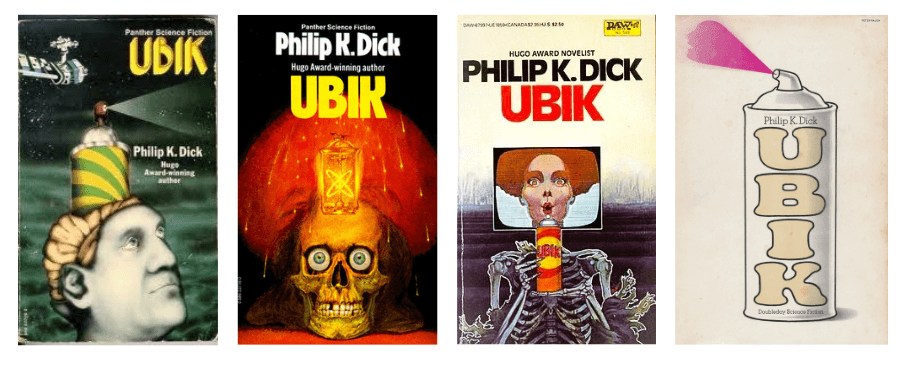
As usual, I’m excited to get into exploring themes and what I think this was all about, and to do so, I will be talking about the plot with spoilers. So if you haven’t read it and don’t want to be spoiled, stop after enjoying this fantastic 60-70s book covers!
There really is nothing like a 1970s pulp mass market paperback cover. It depresses me how boring book covers are these days.
🚨🚨🚨 Now entering the spoilers zone 🚨🚨🚨
Reality is fragile
Right from the very start, Dick begins to pepper the reader with hints that reality can be manipulated. It’s 1992 in a world where some people have the ability to read minds (psychics) and see into the future (precogs). Of course, this being Dick, this power is, naturally, primarily used for corporate espionage. To balance things out, there are also people who have the ability to counter and neutralise psychic activity; these are known as intertials. Glenn Runciter owns and operates Runciter Associates, a so-called “Prudence” company that provides the services of intertials.
The novel opens with Runciter worried about the fact that there has been no psychic activity recently, that all the psychics they are aware of have disappeared from Earth. He is worried about what this means for his business, since he currently has all his employees hanging around with no work to do, and whether this points to a large secret project being carried out by the mysterious Ray Hollister, the employer of all the missing psychics – including the awesome S. Dole Meliphone who just disappeared at 3 am that day.
Soon after, we are introduced to Joe Chip, Runciter’s ‘electrical tester’ (measures psychic activity with a special machine), who is another fantastic Dick everyman character and my favourite of the ones I have read. We first meet him waking up hungover and struggling to operate his “pape machine” because he just wants to read some celebrity gossip. Joe is drowned in debt, and we later learn this because he is terrible with money and spends it on frivolous items. On this day, he doesn’t have the 5 cents needed to open his own apartment door to let in his unexpected visitors.
The door refused to open. It said, “Five cents, please.”
He searched his pockets. No more coins; nothing. “I’ll pay you tomorrow,” he told the door. Again he tried the knob. Again it remained locked tight. “What I pay you,” he informed it, “is in the nature of a gratuity; I don’t have to pay you.”
“I think otherwise,” the door said. “Look in the purchase contract you signed when you bought this conapt.”
His visitors are the Runciter Associates’ intertial recruiter, G. G. Ashwood, and Pat, a new potential. Pat is a 19-year-old girl who has not yet understood time-altering powers, not time travel exactly, but she can change the past and demonstrates this with disturbing ease (somehow PKD manages to use this as an excuse to write about her perky young tits; it’s quite creative). This is an alarmingly powerful ability to have, but our characters treat it with remarkable casualness, although Joe does mark her assessment with a secret symbol to indicate she is not to be trusted.
At the Runciter Associates offices, Mr Runciter has a meeting with a Miss Wirt who is looking to hire 40 intertials. He uses an on-staff psychic to learn that she isn’t what she’s presenting and that she’s really a front for Stanton Mick, the extremely wealthy financier, and the job is to protect a secret project on Luna where they are building a ‘radical, new, low-cost interstellar drive system,’ which is coming under unprecedented psychic attack. Runciter has misgivings but takes the lucrative job, promising his 11 available intertials, including the recently hired Pat.
The names are all so fabulous I can resist listing them; the intertial crew are: Joe Chip, Pat Conley, Tippy Jackson, Al Hammond, Jon Old, Francesca (Francy) Spanish, Tito Apostos, Don Denny, Sammy Mundo, Wendy Wright and Fred Zafsky.
Up to this point, Ubik feels like a relatively straightforward sci-fi mystery, but Dick has already undermined reality in several ways and given us a handful of apparent Checkov’s guns. There are a number of shady characters mentioned (Stanton Mick, Ray Hollister, the awesome Meliphone), and they have psychic attacks, plus we have the time-altering Pat in the midst who was immediately highly suspect, and the characters are off to protect a high-value project with the potential to make interstellar travel and colonisation more affordable.
But that isn’t what Ubik is about. Almost all of these details turn out to be irrelevant!
Once on Luna things start to feel strange. The pivotal scene in which the bomb goes off is so strangely written, the characters so detached, almost like slow motion, that the first time I missed what had happened and had to go back and read it again to understand!
Squeaking in his metal-insect voice, Stanton Mick floated to the ceiling of the room, his arms protruding distendedly and rigidly. “Mr. Runciter, don’t let your thalamus override your cerebral cortex. This matter calls for discretion, not haste; calm your people down and let’s huddle together in an effort to mutually understand.” His rotund, colorful body bobbed about, twisting in a slow, transversal rotation so that now his feet, rather than his head, extended in Runciter’s direction.
“I’ve heard of this,” Runciter said to Joe. “It’s a self-destruct humanoid bomb. Help me get everybody out of here. They just now put it on auto; that’s why it floated upward.”
The bomb exploded.
Half-life
In the first chapter, before Dick even properly introduces the psychics and intertials, he brings in the idea of ‘Half-life.’ The novel opens with Runciter going to talk to his twenty-year-old but long-dead wife, Ella, about his concerns with the state of the business. He visits the Beloved Brethren Moratorium where the deceased are kept in “cold-pac” storage and can be called up by a special phone when their loved ones want to speak to them.
The dead are kept in an extended, but temporary, fragmented sort of reality where they only exist at the convenience of the living; in Runciter’s case, he consults her on business matters (as she had requested). Additionally, their environments can be invaded by other stronger half-life residents who are kept in storage nearby. Ella has a weak signal because she has been dead for so long, and when Runciter tries to talk to her, she is overtaken by a teenager called Jory Miller (the first Chekhov’s Gun).
Ella, pretty and light-skinned; her eyes, in the days when they had been open, had been bright and luminous blue. That would not again occur; he could talk to her and hear her answer; he could communicate with her… but he would never again see her with eyes opened; nor would her mouth move. She would not smile at his arrival. When he departed she would not cry. Is this worth it? he asked himself. Is this better than the old way, the direct road from full-life to the grave? I still do have her with me, in a sense, he decided. The alternative is nothing
At this stage, it isn’t really questioned whether this Half-Life is morally OK, though it should be noted that Beloved Brethren Moratorium is in Switzerland, which I think signals two things. Runciter is very rich; that’s how he can afford a fancy place in Europe when he lives in New York, and it cannot be a coincidence that Switzerland was the first country in the world to legalise assisted dying in 1941. Personally, I was immediately repelled by the idea of keeping the dead conscious in such a way. The instability of it sounded frightening, and the fact that it only seemed to be for the benefit of the living makes it feel cruel.
Time
Runciter is killed in the bomb blast, and the surviving 11 inertials race to get him into cold-pac and to the Moratorium in Zurich. As they work towards this goal, they start to notice that the world and objects seem to be reverting to older versions. At first, a phonebook is out of date, money is wrong, cigarettes have gone bad, and milk has gone sour, until vehicles, elevators and whole buildings begin to change at an increasing rate.
Some changes in the beginning seem quite positive, especially those that walk back the satirical hyper-capitalist elements such as coin-operated doors, but others show that modern progress has not been for the better. The further back times goes Joe has to start worrying about transport options (soon he won’t be able to travel across the country) and medicine.
Time stabilises in 1939, and after an awkward conversation with a taxi driver, Joe realises how much moral, scientific and social progress has been lost, and that the way people relate to the world and each other is so different it is another reality.
This is a world that lives in terms of William Jennings Bryan’s oratory; the Scopes “Monkey Trial” is a vivid reality here. He thought, There is no way we can adapt to their viewpoint, their moral, political, sociological environment. To them we’re professional agitators, more alien than the Nazis, probably even more of a menace than the Communist Party. We’re the most dangerous agitators that this time segment has yet had to deal with
1939 is also significant as the year the Second World War broke out – a world-shaking event, at least in the West – although the USA (where this novel is set) didn’t participate until 1941.
The time element has the reader crying out that it has to be Pat, Pat with her perverse manipulative streak and time-altering powers. Otherwise it doesn’t make sense that she didn’t do anything to stop the bomb, right? Even Pat seems to think it must be her affecting reality, but that turns out to be a red herring. After all, none of this is quite what we’d seen previously when she exercised her powers.
While Pat did have something to do with the bomb, she and G. G. Ashwood were working for Ray Hollistor, who we guess was behind the attack, but really none of that matters in the end and it won’t be solved, because now we realise that the 11 inertials are all dead and in half-life. Runciter survived and is helping Joe from the real world.
A Gnostic Allegory?
The underlying religious themes are so well concealed that I think you can easily read this and miss them entirely; I certainly did the first time.
I will not claim to be any kind of theologian or know much about any Christian doctrine beyond what my Church of England primary school forced on us, and that was a long time ago. I learned the word “gnostic” from reading other people’s very interesting readings of the religious themes in this book – and then I read the Wikipedia entry!
Most obviously, we open the book with an afterlife that is actually a kind of constructed virtual reality. Then all the characters die in real life (12 Runciter employees, like the apostles, and one of them is a traitor), and suffer a shifting reality in half-life, where their beliefs and theories are constantly proven to be wrong, until eventually Joe Chip realises what has happened with the help of divine messages revealing the truth (Runciter) – writing on the walls, in the sky, miraculously appearing objects etc.
It made no sense. And yet, here, too, the pair of opposing forces were at work. Decay versus Runciter, Al said to himself. Throughout the world. Perhaps throughout the universe. Maybe the sun will go out, Al conjectured, and Glen Runciter will place a substitute sun in its place. If he can.
I’ve learned that in Gnosticism you have a flawed, malevolent demiurge creator, which certainly fits Jory, who had been constructing and manipulating reality this whole time. Then there is a transcendent, uncorrupted being who brings order, which fits the Runciters – first Glenn and then later Ella appears, angel-like and gives Joe his lifetime supply of Ubik. Gnostics believe that salvation comes through enlightenment and knowledge of the divine, and it is only when Joe Chip (the big J.C) finally comes to understand his situation that he learns to believe that, with his supply of Ubik, he too can control reality and prevent Jory from devouring him. The Joe Chip coin at the end implies he was able to do more than that.
I am Ubik. Before the universe was, I am. I made the suns. I made the worlds. I created the lives and the places they inhabit; I move them here, I put them there. They go as I say, they do as I tell them. I am the word and my name is never spoken, the name which no one knows. I am called Ubik, but that is not my name. I am. I shall always be.
Ubik is, of course, God. God in the form of an aerosol, because this is Dick. Ubik is protection; it shields Joe from Jory’s attacks and gives him the assurance he needs to grow stronger.
Satire
I mean, yeah, God is an aerosol. A packaged-up and marketed product that promises to improve your life and save you from all those little difficulties (most of them invented by ad men). Every chapter starts with an Ubik ad; they’re all great, but here are just a few.
Instant Ubik has all the fresh flavor of just-brewed drip coffee. Your husband will say, Christ, Sally, I used to think your coffee was only so-so, But now, wow! Safe when taken as directed.
If money worries have you in the cellar, go visit the lady at Ubik Savings Loan. She’ll take the frets out of your debts. Suppose, for example, you borrow fifty-nine poscreds on an interest-only loan. Let’s see, that adds up to-
Taken as directed, Ubik provides uninterrupted sleep without morning-after grogginess. You awaken fresh, ready to tackle all those little annoying problems facing you. Do not exceed recommended dosage.
Lift your arms and be all at once curvier! New extra-gentle Ubik bra and longline Ubik special bra means, Lift your arms and be all at once curvier! Supplies firm, relaxing support to bosom all day long when fitted as directed.
It is also interesting to note that the Runciters, our transcendent divine beings, have a business model built on stoking up paranoia around psychics; Ella’s advice to him is to start running hourly TV ads again.
This makes perfect sense within this hyper-capitalist consumer world, which has gone so far as to slap a subscription into absolutely everything, including your front door and your fridge… this felt like satire in 2018, but in 2026 this is actually the world we live in now (where it is possible to get logged out of your toothbrush, there are landlords that fit smart door locks and then charge subscription fees, and I’m sure we’ve all heard about the diabolical HP printer subscriptions).
I think there is also something in the fact that Jory – who died at 15 years of age, a long time ago – is allowed to consume the half-lives of others because he has a very rich family who actually pay for him to be able to do so. The half-life afterlife is only available to those who can pay for it, and even then the wealthiest people will still literally consume your life force to extend their own
The fashion
Oh my gosh, do I wish I had illustrations of every character in this, because the clothes… the descriptions of the clothes are fabulous. Just for fun, I will include some:
- “After he had dressed – in a sporty maroon wrapper, twinkle-toes turned-up shoes and a felt cap with a tassel” (Joe)
- “Square and puffy, like an overweight brick, wearing his usual mohair poncho, apricot-colored felt hat, argyle ski socks and carpet slippers” (G. G. Ashwood)
- “A young stringbean of a girl with glasses and straight lemon-yellow hair, wearing a cowboy hat, black lace mantilla and Bermuda shorts; that would be Edie Dorn. A good-looking, older, dark woman with tricky, deranged eyes who wore a silk sari and nylon obi and bobby socks; Francy something, a part-time schizophrenic who imagined that sentient beings from Betelgeuse occasionally landed on the roof of her conapt building. A woolly-haired adolescent boy wrapped in a superior and cynical cloud of pride, this one, in a floral mumu and Spandex bloomers“
- “He wore old-fashioned, hip-hugging gold lame trousers, yet somehow created a stylish effect. Perhaps the egg-sized buttons of his kelp-green mitty blouse helped; in any case he exuded a grand dignity“
- “He wore a polyester dirndl, his long hair in a snood, cowboy chaps with simulated silver stars. And sandals.“
- “Potbellied, squat and thick-legged, Stanton Mick perambulated toward them. He wore fuchsia pedal-pushers, pink yakfur slippers, a snakeskin sleeveless blouse, and a ribbon in his waist-length dyed white hair.“
Incredible.
The ending
Ubik has one of those “wait, what?” endings. The final scenes have Runciter hanging up the phone in the Moratorium, where we assume he is still alive and the 11 others died. Then he goes to tip the staff member helping him and notices the coin has Joe Chip’s face on it. So is Runciter dead too? And if he is, what does that mean for everything we just read?
Personally, I took this just as a final fun little jab at the reader that felt in keeping with the rest of the story. We only know the reality of our own experiences, and those are not necessarily reliable. If you think about it too much, you’ll end up in a metaphysical nightmare, just like Ubik.
I will definitely re-read Ubik for a third time in the future; I know there is more I could get out of it. I understand more Dick novels focus more on religion (I think VALIS in particular) and, especially after he had his own revelatory experiences with visions, which I hope to learn something about when I read his biography and The Exegesis of Philip K. Dick. I also know very little about metaphysics at the moment, though it is on my list of things to learn more about. I also have Philip K. Dick and Philosophy in my collection to eventually get to.
For Law of Fives, this was my 3rd Dick this year, and I think I could count it as horror under my SFF genre exploration.
REVIEW SUMMARY
I LIKED
- Exploration of deep themes – everything is unreliable!
- Joe Chip is a great character.
- The satire of subscription services in everyday items was brilliant… but also depressing in how prophetic it was/
- Layered and really rewards repeat readings.
- God as an aerosol, inspired!
I DIDN’T LIKE
- Minor niggle, the descriptions of 19-year-old Pat and her perky tits were sometimes uncomfortable (but this was written by a man in the 1960s and it’s fairly mild by that standard!)