

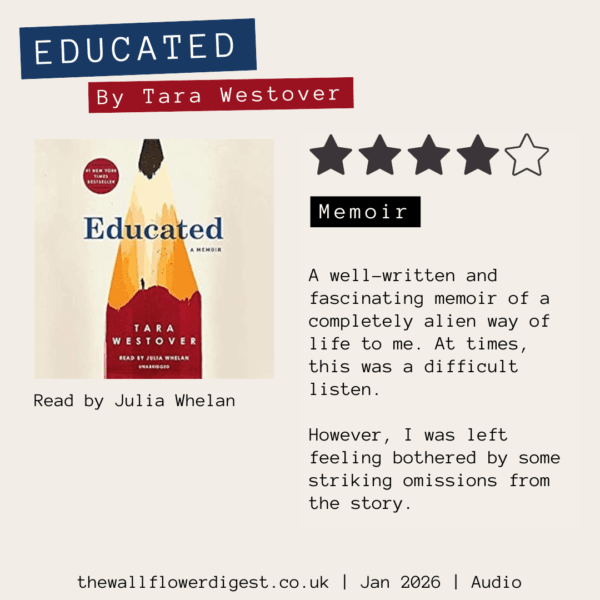
⭐⭐⭐⭐ 4/5 – A fascinating memoir that gave me a window into a whole other world but left me curiously unsatisfied.
Format: Audio (BorrowBox)
Read: January 2026
I hadn’t heard of this book before I saw it in the second-hand ‘buy three get another free’ section on World of Books recently, and I just thought the cover looked interesting. I decided to see if the library had an audiobook rather than committing to a paperback, and it did! Despite my never having heard of it, apparently, this book did cause a bit of a stir when it came out in 2018.
This is the memoir of Tara Westover, a woman who went from growing up homeschooled in her family’s scrapyard in rural Idaho to getting a PhD from Cambridge. The title implies it is the story of her quest for knowledge and her journey to educating herself, but it actually reads more like an abuse memoir, as it very much focuses on her chaotic and dangerous early life with her family. It doesn’t ruminate much practically on her self-education or the deconstruction of the beliefs she grew up with, so it wasn’t quite what I thought I was getting, but it was an intersection of topics I find interesting and certainly a way of life and experience that is completely alien to me.
Isolation and extreme ideologies
While her parents are not outright abusive, their beliefs certainly lead to a dangerous home environment in which multiple family members suffered a horrific and life-altering injury that was entirely preventable. The Westovers are Mormon survivalists who believe in the usual kinds of anti-government and world ending cospiracy theories that would lead to a distrust of public schools and the medical establishment. Going to the doctor or a hospital was unthinkable, and instead, all ailments – including head injuries, car crashes and serious burns – are treated at home by her mother’s herbal remedies. I caution you, there are some very graphic descriptions of burns and head injuries that are hard to listen to.
Her father has a baffling attitude to health and safety in the scrapyard in which he has his young children work. An attitude that persists after burns, terrifying falls, head injuries and close calls for lost limbs. The family got into two very serious car accidents due to driving through the night while exhausted. The first one left the mother with a brain injury that, by Tara’s account, she never truly recovered from. Reading this book did help me understand the bizarrely high rate of car accidents that the extreme religious fundamentalists I used to follow via the FundieSnarkUncensored subreddit would get into. Apparently, they are very happy to leave the fate of their entire families, and anyone else they might plough into, “to the angels.”
The most direct abuse that Tara suffered was at the hands of her older brother Shawn. By her account, he showed signs of violence and a proclivity for tormenting and abusing young women before, but over the years, he suffered not one but two serious injuries to his head that seemed to only increase his volatility. Her parents’ complete failure to protect her when it was clear to her that they knew what was happening, and indeed happening to his later wife, is what she credits as the reason she finally left and eventually cut off ties with them.
Tara’s story is not a neat one, as is usually true of life. While her parents certainly didn’t protect her from harm, they also didn’t seem to have prevented any of their children from pursuing education if that was what they wanted. Two of her elder brothers left for school before her, and now all three of them have PhDs. Her parents allowed her to learn, even if she had to buy her own textbooks and get herself there. As a child, she’s taken to dance classes and is a talented singer, of which her father is proud, and she joins a theatre group. She isn’t locked up at home; her interests are encouraged, she goes to work outside the home and has her own money. They’re also not technophobes; they have a home computer and get internet access – they use email, and their business to this day is selling herbal oils and home remedies online.
Her story is more about the slow process of breaking down the mental cage she was in, growing up in such isolation with only the beliefs of her father, who appears to have been more extreme than the average in their wider rural community.
I really enjoyed this book; it is very well written and engaging, and served as a fascinating window into a world completely alien to me. However, I was left feeling curiously unsatisfied by it. When I sat and thought about it a bit, I realised it’s because several strange omissions in Tara’s story bothered me. So while I’m now going to muse on several rhetorical questions, and maybe have a bit of a moan about it, I thought this book was great, and I recommend it! It made me think, and that’s the sign of a good book.
Originally, I thought I would be musing on the nature of memoirs, which are a very tricky medium. Human memories, we all know is unreliable and more so the further you try to go back. A memoir can only be the Truth as it exists in the mind of the author, and other people in the story will have had a different experience (certainly her parents dispute it, and he mother even wrote her own memoir). Tara does acknowledge several times that she recalled an event one way, and having spoken to others, they remembered something else. There is also the way that continued lived experience can transmute past experiences in our memories, as we gain new understandings that can recontextualise. Tara’s story is also layered in the way that she experiences attempts by her family to rewrite the past in her memories, and those around them, to protect Shawn from her accusations, and she becomes the one “with the devil in her.”
I am sure there would be more to say on that, and Tara’s interest in studying historiography, but that isn’t what ended up sticking with me from this book.
Who is present-day Tara, and what does she believe?
I was trying to understand why I felt so bothered having finished the book when I found this excellent piece by Rebel-Mouthed Books (it’s a long piece, but it’s worth it!), I think they hit the nail on the head. I agree, my dissatisfaction with the memoir is because the Tara Westover of 2018, the one who wrote this book, has no presence in her own story. We never hear the opinion of present-day Tara; she doesn’t reflect on her growth or change outside of the moments she relates in the memoir. There are obvious subjects that flow through her life story – feminism, racism, misogyny, conspiracy theories, religious extremism, and privilege – which she often gets close to saying something about before backing away. In the end, Educated is focused on the opinions of her father, and Tara, as the author, leaves them to just hang in the air.
There are numerous examples of this, and I’d probably find more if I re-read it. The first thing that immediately stood out to me was when she talked about her first encounter with feminist texts while at university. She instantly rejects the writers of the second wave of feminism and discovers her favourite feminist writer to be John Stuart Mill. A man, you can’t help but notice, but also a man writing in the 18th Century. She also writes her PhD on his philosophy, so he clearly struck a chord, but she never goes any deeper on this. She never explains why she is only comfortable with the feminism of a man! Was it just during that time in her life, as she was early in her education? Has her opinion on second wave femenism changed now?
This also feels uncomfortable alongside the fact that she never acknowledged her luck and privilege at the opportunities that got her to where she is. As a Brit, it seems absolutely nuts to me that this girl, who didn’t go to high school, lied and scraped her way into Brigham Young University, and got to go to Cambridge. That doesn’t just happen because you’re really clever; there are thousands of really people clever enough to go to Cambridge who don’t get the opportunity to (and if she were British, this whole story would be even more unbelievable and definitely less magical). The truth, as I see it, was that she was helped along that way by a series of men, and the luck of an LDS University paying for study abroad courses at a prestigious institution. This is no fault of hers for taking everything she got, I’d be mad if she didn’t… It’s just strange in the wider context not to discuss the elephant in the room.
It was her two elder brothers who paved the way to College, Tyler in particular taught her maths and gave her the idea to go in the first place. Once at BYU, she lucks out with a Bishop who is incredibly understanding of her situation and seems to go above and beyond to support her (it sounds like at times out of his own pocket). She gets the attention of a Professor who gets her onto the study abroad programme at Cambridge, which gets her the attention of a Professor there, which arguably puts her on the path to opportunities with Harvard and her Cambridge PhD. I will say there is an element of “not like other girls” in this section of the story, which probably wasn’t intentional, and she doesn’t acknowledge that this whole series of events – no matter how hard I am sure she worked and how much she deserved it (she’s evidently talented, this is a heck of a book) – is like a one in a million chance!
There is also a time when she recounts her parents’ final visit to her at university, I think she was at Harvard for this, when out for dinner, her father starts ranting loudly about The Protocols of the Elders of Zion and various anti-semitic conspiracy theories. This is everything she says on the subject after recounting this incident, mostly the scene just serves to illustrate the ever-widening gap between her and her family:
The document was discredited as a fabrication until it spread, fueling anti-Semitism in the decades before World War II. Adolf Hitler had written about the Protocols in Mein Kampf, claiming they were authentic, that they revealed the true nature of the Jewish people.
When I heard this on the audiobook, I did a double-take. I clearly remember it, I paused doing the washing up. That’s an oddly weak passage, isn’t it? It doesn’t firmly state that the document IS a fabrication, the sentence structure lets the possibility hang that, since it started to spread, maybe it is authentic? What are your opinions on this, Tara of 2018?! You have me worried, and again, in the context of her story, a key turning point was never knowing a single thing about the Holocaust until she was in college, so her failure to clarify her own thoughts grows into a noticeable hole.
There is another time when white supremacy is skirted past, in the context of her father’s obsession with Randy Weaver (of Ruby Ridge) and his family being shot at by government agents in a raid on his property.
“There was one thing I still didn’t understand: Why had the federal agents surrounded Randy Weaver’s cabin in the first place?… I remembered Dad saying it could just as easy be us. Dad was always saying that one day the Government would come after folks who resisted its brainwashing, who didn’t put their kids in school…According to the sources, including Randy Weaver himself, the conflict had begun when Randy sold two sawed-off shotguns to an undercover agent he’d met at an Aryan Nations gathering. I read this sentence more that once, many times in fact. Then I understood: white supremacy was at the heart of this story, not homeschool.”
I think there is an implication here of how and how well her father knew Randy Weaver, and whether they knew him from the Aryan Nations. When her father is talking about “brainwashing” what does he actually mean? Tara doesn’t try to make any potential connections between motives for homeschooling and white supremacy, but we know her family were racist from the n-word nickname her brother used to call her when she got covered in grease and grime at work. Slavery and the n-word are at least something that she does address more directly.
Another issue I felt she left hanging was the distrust of the medical establishment. By the end of the book, her mother has grown in power and has a small cult-like following in the community who believe in ‘energy healing’ and herbal remedies. The family has grown very wealthy thanks to the online business taking off. This appears to be in large part because of the numerous horrific accidents that befell the father and brothers over the years, which miraculously didn’t kill them and serve as a kind of proof of the power of faith. At this point, Tara has been taking painkillers and going to the doctor and the dentist, and taking her brother to the hospital after he was in a motorcycle accident, which is a major turning point in her journey towards leaving home. She also expresses frustration and sadness at the permanent disfiguration her father has because he refused to go to the hospital after most of his body was on fire!
What I would have liked was an exploration of this distrust of doctors and hospitals in her family, as well as the reliance on faith healing and herbal remedies in the community. What might be the root of these conspiracies? Does the fact that this is the United States of America, where there is no national health service, and it’s incredibly expensive, have anything to do with it? Her family were poor for most of her young life, and I am sure did not have health insurance. This never comes up.
Religion is also largely left out of the picture once Tara is away at Harvard and Cambridge. I am left wondering what she believes now, and the role that Mormon beliefs (which, in the ways they affect women, are the same as any misogynistic antiquated religion) played in her early life. This has to have been part of her deconstruction of her father’s worldview. There have been a few breadcrumbs of her pushing modesty rules, trying alcohol, and realising she didn’t agree with “a woman’s place is in the home”, but little beyond this, and it remains unaddressed. If she is still religious, that is completely fine. I’m just interested in how she reconciles this with everything she has learned on her journey of education, because you cannot separate out the role of religion in her story.
Who does she see as her audience?
These curious omissions left me wondering who she was writing this book for. Is it for her past self and girls like her? Perhaps she worries that being explicit about her present-day “liberal” opinions would alienate those at the start of their journey? Perhaps she worries that really laying out her family’s bigoted, racist and antisemitic beliefs will make them even more of a target than they ended up being (they did receive quite a bit of hate after this book came out). Or that admitting that she herself used to think this way makes her a target for hate, or is just too difficult or alienating for her current, (presumably) more liberal community of academics? Or maybe it’s just that she does still believe some of these hateful things, and that woo-woo medicine and herbs can cure cancer?
Or maybe in 2018, she is still trying to figure all of this out. That would be entirely understandable. Rebel Mouthed Books points to the choice of book title. “Educated” implies that she sees her education as complete, and maybe that is what is so bothersome about it. It can’t be complete when she has left so many crucial holes in the story. In the USA of 2026, it feels especially dangerous to have put something like this out and leave it with all of these themes so open to interpretation.



I picked this up in 2018/9 as it sounded interesting. I put it down after the graphic fire and putting a leg in a rubbish bin with water. Or something like that. I tried to wipe it all out of my mind. At the time, I thought I’d pick it up again when I could stomach some more, but I never did, and last year I finally removed my bookmark and donated the book to Friends of the Library.
Your excellent review tells me I made the right decision, and yes, it does highlight my thoughts – I was not getting what I was expecting. I’m glad I ended up missing even more, in the graphic injury depictions.
Oh yeah the leg burn is nothing compared to what happened to her Dad 😱
Though I may have found the thought of all the bin bacteria on the burned leg more disturbing to be honest!