
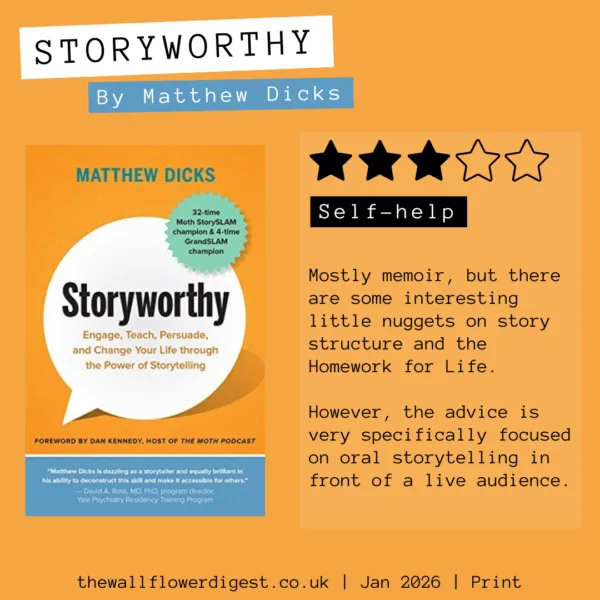
⭐⭐⭐ 3/5 Stars – This wasn’t what I wanted it to be, but some interesting nuggets once I pushed through.
Format: Print
Read: January 2026
The full title of this book is Storyworthy: Engage, Teach, Persuade and Change Your Life through the Power of Storytelling.
I decided to read this because I’d heard about the ‘Homework for life’ exercises in a YouTube video about Obsidian, or note-taking or something, and I thought it sounded like an interesting concept. I want to get better at connecting with people, and it sounded like this might also improve my blogging. The blurb on the back certainly tries to sell it this way.
Unfortunately, that isn’t what this book is, and I missed some key points in the book’s description. The author is a professional storyteller. He enters and wins competitions in storytelling – who knew that was a thing? But then, of course, it is a thing because he’s American, and it seems like there is nothing Americans won’t make a literal competition out of! I should have thought about this aspect more because every time I read a self-help book by an American, I find there is a culture clash.
This is a book about a very specific type of storytelling – oral stories that are being performed in real time to an audience. That might be on stage at a competition, a presentation, sales pitches or teaching a lesson (Dicks, unsurprisingly, was a teacher… he very clearly loves an audience).
There are some interesting little nuggets in Storyworthy, which I think in the end did make it worth struggling through, but you really have to be able to ignore the author’s blaring ego to get to them. You will hear over and over, and over, again about how great this guy is. How fantastic he is at storytelling, what a wonderful teacher he was, beloved by the community, how entertained everyone is by him, and two stories that include his past sexual relationships. Almost every example of a good story used in this book is written by him, which, given the arrogance I was reading in his voice, I found quite funny.
The overall impression is that this guy loves the sound of his own voice, and I personally would find him insufferable to be around. I couldn’t help but read the bit where he talks about his friends saying he has “a story for everything” in the British way, which would be to imply that he never shuts the fuck up and just take a hint, mate.
But once I made myself see past our personality clash, there were some things in this book that gave me food for thought.
The interesting bits
Storytellers seek to constantly make meaning from their lives.
We contextualize events, find satisfying endings to periods of our lives, and struggle to explain how our lives make sense and fit into a larger story.
Stories should help us connect to ourselves and others
The early chapters focus on what Dicks sees as the benefits of storytelling and his USP for this book. I agree that stories should be about connection. It’s why I am a character-driven reader, and I don’t care about plot if I can’t connect to the characters.
Your story must reflect change over time. A story cannot simply be a series of remarkable events. You must start out as one version of yourself and end as something new. The change can be infinitesimal. It need not reflect an improvement in yourself or your character, but change must happen. Even the worst movies in the world reflect some change in a character over time.
I appreciated his encouragement for us all to look at our own lives and note down the small moments of connection we have to ourselves or the people around us. I think this is useful for storytelling ingredients, but possibly even more useful as a self-reflection tool.
Homework for Life
This is where his exercises come in. There are three exercises mentioned:
- Homework for life – every day, note the most “storyworthy” moment of the day. If you were to tell a story from this day, what would it be? He recommends you do this in a spreadsheet to make it easy to search and scan down to look for patterns.
- Crash and burn – basically just stream of consciousness writing. I’ve not read it, but I’m pretty sure this is just the same concept as morning pages in The Artist’s Way.
- First, Last, Best, Worst – write out a table for different prompts with a column for your first, last, best and worst experience of that thing (e.g. kisses, cars etc) and see if any are “storyworthy.”
Homework For Life is something I’m thinking of trying as an experiment this year. Maybe not every day – because sometimes nothing happens all day, especially when I work from home! Though I suspect it might make me reflect even more on how boring I am, and I could do with feeling less boring!
What is a ‘story’ in Matthew Dicks’ definition?
Again, it is important to remember he’s very specifically talking about orally performed stories.
- True and told by the people who lived them.
- They require vulnerability.
- Reflect change over time (even if a very small change).
- They are about a 5-second moment in the storyteller’s life.
Folktales are not stories, he says, because they fail on the first and second points.
I thought this quote was a good summation of why his techniques are not going to apply to all types of storytelling.
A written story is like a lake. Readers can step in and out of the water at their leisure, and the water always remains the same. This stillness and permanence allow for pausing, rereading, con-the use of outside sources to help with meaning. It also allows the reader to control the speed at which the story is received.
An oral story is like a river. It is a constantly flowing tor rent of words. When listeners need to step outside of the river to ponder a detail, wonder about something that confuses them, or attempt to make meaning, the river continues to flow. When the listener finally steps back into the river, he or she is behind. The water that has flowed by will never be seen again, and as a result, the listener is constantly chasing the story, trying to catch up.
To keep your listener from stepping out of your river of words to make meaning, simplification is essential. Starting as close to the end as possible helps to make this happen. Sometimes the closest place to start is thirty years before your five-second moment. If that’s the case, so be it. But when that beginning can be pushed closer to the five-second moment, your audience will be the better for it.
Tips for constructing a powerful story
There are some interesting tips for constructing stories that could be more widely applied to other forms of storytelling.
- All stories are about a 5-second moment in a character’s life where something changed – no matter how big or small.
- Find this moment to identify what the story is about and then work backwards to craft it.
- Less is more; you want brevity.
- Start near the end to cut out unnecessary detail.
- Start with forward movement for instant momentum
- Don’t start by setting expectations. No thesis statement. No summary. You want a surprise.
- Have a clear location so the audience can picture it, like a movie.
- Use ‘but and therefore‘ to zig-zag and keep your sentences active and interesting.
- It’s the causal links that make a story flow in an exciting way (he cites Trey and Matt Parker discussing this as a technique they use in South Park).
- This happens, then that happens, but then this happens, therefore that happens.
- In a written story, this would happen through different scenes or chapters.
- Using negatives in descriptors can be more powerful.
- For example, “I am not at all good-looking” holds more possibility than “I am ugly.”
- Use the present tense to draw the reader in (if you can pull this off).
- Failure is more engaging than success. Success stories need an underdog.
- Avoid anachronisms.
- A story needs stakes to hold interest. He has a few devices he uses:
- The elephant is the obvious that tells the audience what to expect. You want to open with this.
- You can surprise your audience by “changing the colour of the elephant” and changing the emotional direction of the story.
- The backpack is building anticipation (e.g. hopes and fears) and emotion.
- It’s outlining the plan before you do it. Very effective when the plan does not work. Perfectly executed plans don’t make good stories.
- Breadcrumbs are hints at future events, but still keep the audience guessing.
- Particularly effective if the outcome is unexpected.
- This should be fuel for the later payoff. It’s good to camouflage them with a laugh.
- Hourglasses are controlling the pace. Keep the audience hanging when they’re more invested.
- This provides more evocative detail and description right before the payoff.
- Crystal balls are a false prediction, but should be used very strategically and only when appropriate.
- The elephant is the obvious that tells the audience what to expect. You want to open with this.
- Humour helps to keep people listening. A laugh from the audience:
- Assures them they are in good hands, and is a sign of their approval.
- Tells any interrupters that you have the floor.
- If it’s a serious story, it can alleviate awkwardness by signalling you’re ok now, and that the story is in the past.
But what is authenticity?
Throughout the book Dicks is at pains to craft what he calls authentic stories. As we know, they should be true and try to connect with the audience over this 5-second moment of transformation in your life. To actually be entertaining to your audience, though, you have to carefully sculpt it, and in acknowledgement of this sticky issue Dicks includes a chapter on when it is ok to “lie” in your stories. It was this chapter that made me feel quite uncomfortable with his whole proposition.
His focus is telling stories from his own life, and obviously, his own life includes other people – his friends, his family, his students, his wife, etc. He admits that memory is a slippery thing and that most of the time, people will have a different recollection of a past event from him or will have remembered different details. I think any ethical issues around this depend on the reason you are telling stories and whether in a public forum, but the idea of carefully editing and crafting stories from your past life and the potential for the person who tells the “best” (or loudest) story to change reality is something I find disturbing.1
Does striving to make a story “more authentic” through such painstaking editing make it inauthentic?
The more I think about the vibe of this book, the more manipulative it feels. For Matthew Dicks attention is currency, and he’s mastered the art of editing his stories to get as much of it as possible. I question the motives, and it feels like this isn’t about making connections for the sake of human connection – it’s mining them for personal gain. It’s prizes, trophies, viewers, ad revenue, sales commissions, book sales etc. After all, this is a performance and not a conversation. There is nothing inherently wrong with that if you’re being honest about it; I just realise it’s just not what I am personally interested in or my motive for reading this book.
I think this also gets my back up because, as a quiet and socially anxious person, I don’t like this reality where attention is something that we have to compete and manipulate with each other to get. Which brings me on to..
But what if I don’t live a dramatic and exciting life?
Another thing I learned from this book is that Matthew Dicks hates boring people, and he doesn’t want to hear from us. Trying to steal his precious attention with a boring story is unforgivable.
The problem is that he has lived a dramatic and exciting life by his own account. He grew up in poverty and had to fend for himself from the age of eighteen. He was held at gunpoint, he was almost fired as a teacher, but was saved by the community, and he nearly died in a car crash. Sure, he says you don’t need to have a dramatic and exciting life to tell a good story… but he uses all these dramatic events as the attention hook in his own examples.
He doesn’t give any examples of stories he has crafted that are from more mundane, relatable experiences, even his ‘5-second moment’ is universal. I would have appreciated him jazzing up a meaningful moment found in a ‘boring’ story, that didn’t relate to his dramatic past. That is what I need!
Perhaps if I do his Homework for Life exercise, I will begin to find these moments and work out how to craft them into stories for myself. However, right now, with my current goals and interests, I am not sure of the value of that.
But what if I don’t have an audience?
I don’t see how I could apply any of this to my life when I’m never in front of an audience (and don’t want to be!). How often in real life are most people finding themselves in front of a group of people receptive to them telling a 5-7 minute long personal story, an emotionally resonant moment? Is this normal for Americans? And how often are people telling this kind of deeping meaningful story to random strangers?
I see this sort of stuff in TV shows and movies… I have never seen it in real life.
In fact, I find it incredibly rare that anybody genuinely listens when another person is speaking in a conversation. Usually, they’re thinking about how they can next speak, which too often is a change of topic to themselves. Maybe it’s just the people I know in my life, and the impressions they have of me, but I find it very hard to imagine being about to relay a story in the way Dicks describes.
Where I think some of the ideas in the book could be useful is in writing character moments in fiction if you have a character with a penchant for telling stories, or maybe sharing stories on this blog, though that isn’t really the kind of blogging I’m interested in doing. Maybe it will also aid me in spotting patterns in stories I consume in other media, and be more aware of the devices being employed by writers.
And so for now, I don’t think this book is likely to prove of much value to me, but since I am picking up journaling again, I will keep this idea of Homework for Life in the back of my mind and see if it comes to anything. More likely, I may return to some of these ideas in the future if I ever decide I want to try writing fiction again, or more of a memoir style.
I give it three stars because I don’t think it was a complete waste of my time, but I don’t think I would recommend reading it to anybody else. You can easily find the sum total of practical advice in my own post and in numerous summaries and reviews elsewhere online, unless you have a desire to read the author’s ego-stroking memoir.
- Especially in 2026, when Donald Trump is a second-term President of the United States. I have also just read Educated by Tara Westover, which has me ruminating on memoirs. ↩︎