
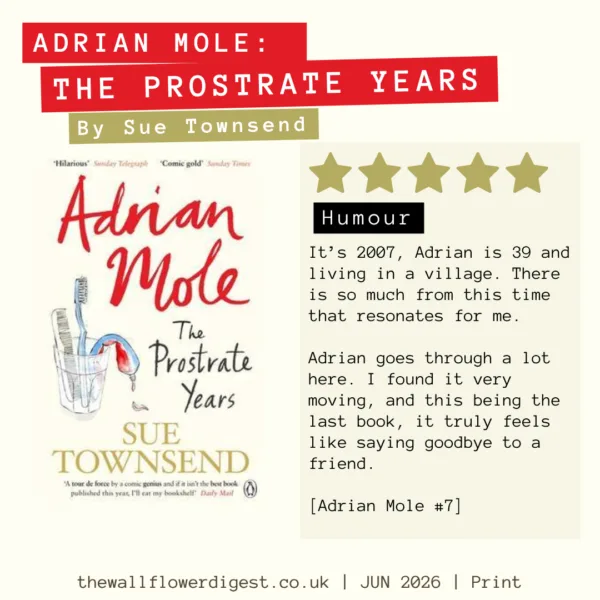
⭐⭐⭐⭐⭐ 5/5 – I hate to say goodbye.
Format: Print
Read: June 2026
Note: I’ve realised there is another book in this series The Lost Diaries of Adrian Mole 1999-2001, that contains entries originally published in The Guardian as a newspaper column, then later published in book form, which messes up the order of the series. That one takes place before Weapons of Mass Destruction, even though it came out in book form after. That makes Lost Diaries technically book 6, WMD book 7 and Prostrate Years is book 8. But, I don’t have Lost Diaries, publisher shenanigans are annoying, and the reviews for it aren’t great, so I’m skipping it! I flicked through it in Waterstones, and I don’t feel like I’m missing much.
I feel emotional about this final book in the series. Adrian goes through some very difficult experiences, and I really felt for him. This book made me realise how much I’ve grown to care about this fictional man, and I do want the best for him. I found myself rooting for him here more than I ever have before, and I’ve felt genuinely sad about finishing this series all week.
Following the events of WMD, Adrian had to move in with his parents (again) at the piggeries in the Leicestershire village of Mangold Parva. Once a field with two old pig sheds, it now has two semi-detached houses. Brutal, they presumably couldn’t afford to build detached and thus must share a party wall with George and Pauline! And as we also know from the end of the previous book, he married Daisy Flowers, and they have a daughter, Gracie.
When the flood had receded somewhat, I sat down with Gracie to watch television. Postman Pat has been promoted, he has got to leave Greendale Village and his red van to move to a middle-management position at Head Office. Some fool at the BBC said, ‘We are taking Postman Pat into a dynamic new environment. There will be highly charged storylines.’ So even Postman Pat is sacrificed on the altar of progress. Without his uniform and his red van, Pat is nothing. NOTHING!.
(I looked this up and this is, of course, real. Though it aired in 2008, not 2007.)
At the end of WMD, Adrian said that nobody happy keeps a diary, so the fact that we are getting this insight into his life again means that things aren’t going well. At the start of the diary, it is 2007, and he’s 39. Now I remember first reading this in my early twenties and thinking he was so old and “middle-aged” … and now I’m only a year younger than Adrian, I can relate to him a lot more, and he’s not old at all! His chief worry as we dip back into his life is that Diasy is very clearly unhappy. She’s a London girl, she likes expensive clothes and glamour and parties, and so life in a field in a tiny village has not been good for her. She’s taken to alcohol and binge eating biscuits, and has consequently put on a lot of weight for her short frame.
Adrian, for his part, doesn’t seem to have any idea how to make her happy and often makes things worse. He’s particularly bad at dealing with her insecurity and low self-esteem. Seemingly having learned nothing from the Marigold debacle, he allows himself to be dragged into an awkward situation with a female customer, despite not being attracted to her, which does not look good; and a particular issue for Daisy is that Pandora is still in his life. Still, he doesn’t deserve the humiliation of her public affair… especially not when he is suffering through cancer treatment. The way this all goes down is incredibly cruel and broke my heart for him.
At one point Daisy accused me of causing her ‘mental anguish’ by telling her things about politics’. She ranted, I’m really not interested who said what on some parliamentary select committee. You must be the only person in the whole of Britain who watches BBC Parliament. You only watch it because you want to letch over that hard-faced slapper, Pandora soddin’ Braithwaite.’
Diary, this was only partly true. I actually enjoy being informed of the finer details of the Finance Bill.
She said, ‘When I first fell in love with you, I thought you were fashionably geeky, but I’ve since found out that you’re not fashionably anything, you’re just a geek!
Daisy was too much like his mother, Pauline, to be a match for Adrian. She’s glamorous, impulsive and loves romance and attention, and isn’t intellectually curious. The red flags were there when she pursued Adrian as her own sister’s boyfriend! Speaking of Pauline, the question of Rosie’s paternity becomes the subject of a Jeremy Kyle episode featuring both of Adrian’s parents – his Dad, now wheelchair bound after a stroke – Rosie and Rat Fink Lucas. The lure of national television is too much for them, and wins out against the risk of public humiliation for airing their dirty laundry. I also loved that she was writing her own misery memoir, titled “A Girl Called Shit.“
The other product of the Mole’s extramarital affairs is Brett Mole, son of Doreen, aka Stick Insect. The book opens with them attending her funeral, and there were some big continuity errors here that bugged me! In The Growing Pains it is Doreen who leaves George, and she marries her ex-partner and father of her son, Max (aka Maxwell House). Whereas in this book, a huge deal is made over the fact that George left her to go back to Pauline, and Doreen never got over George! No, that isn’t what happened! Anyway, Brett Mole is a finance bro… and this is 2007-8, so we know what’s coming. He ends up living with George and Pauline for a while, being a whiny little bitch and trying to get hold of their life savings.
Snittingham, that The Bear was losing £500 a week. He said, ‘It’s bleddy Gordon Brown’s fault, he’s hand in hand with the supermarkets. You can buy a crate of Carlsberg for tuppence ha’penny in Tesco. Nobody’s going to trek to a pub and pay two pound twenty a pint and then be told they can’t have a fag, are they?”
Hahahahaha £2 a pint! More like £6 now, if you’re lucky!
There are other signs of the economic downturn. The local post office and the local pub both close, which removes the centre of the community. Being from a Leicestershire village myself, this was all too familiar! There were signs of it in the last book, but Mr Calton-Hayes can no longer afford to keep the bookshop open. This is a double blow for Adrian. He had finally found a job he was good at, that he even thrived in, and Mr CH was his friend and mentor, arguably the first person in his life who had true patience for Adrian, with whom he could have intellectual conversations about the books he loves, and truly supported him. It ends up as a Tesco Metro, because of course it does.
For some reason I always feel comforted when I am in Woolworths. When I was a child, I spent my first pocket money there. I was five years old and forked out twenty pence on flying saucers. It is good to know that whatever travails we may suffer in life, Woolworths will always be there.
(RIP Woolworths, I also have fond memories of their pick and mix and browsing the CDs and toys.)
Losing the bookshop also displaces Bernard Hopkins, who’s been a bit of a nightmare in the shop – an elderly alcoholic law unto himself – but in a touching turn of events, he ends up being a great friend and support to Adrian while he is extremely unwell with chemotherapy for prostate cancer. After all the octogenarians Adrian has found himself reluctantly “responsible” for (particularly Bert and Archie Tate), it was sweet to have him being cared for by Bernard. A man he’d shown kindness to by offering him a place to stay when they both lost their jobs.
She said, ‘You’ve grown to be an incredibly attractive man. You’ve kept your figure and, thank God and hallelujah, you’ve finally had a haircut that suits you. I’m so glad to see the back of that dreadful side parting, and you’ve finally taken my advice and stuck to dark clothes. Any man in pastel clothing looks like he’s on holiday in Majorca.’
Pandora is still around, actually more so than she has been for a few books now. She’s still a Labour MP and seems to be growing increasingly discontented with her life and relationships. She gives strong signals that she might be interested in Adrian again, and through her compliments, we learn Adrian is hot now (which I think is also evidenced by Daisy’s interest in him, and Dr Pearce seeming to lose her damn mind). Adrian doesn’t seem to entertain fantasies of them getting back together – to be fair, he has a lot going on, which shows he’s matured. The book ends with Pandora arriving at his house, and the first time I read this, I groaned because I always hated Pandora (as her ex Rocky once said, she’s a user). But this time around, I wouldn’t mind an ending where they got together. Adrian has grown a lot. I think he could handle her now, and she is still the only girlfriend he’s had who has come close to understanding him and shared his more intellectual interests.
Now I think about it, maybe I fancy this Adrian? I would not have thought this from the previous books, but now, mature at 39 years old, and a hot bookseller? Sounds alright to me!
There were so many things in this one that resonated with me, possibly because I was old enough to be conscious of the news (in 2009, when this was published, I was 21, graduating, and joining the masses who couldn’t get a fucking job because of the Credit Crunch!). Gordon Brown as Prime Minister, the crazy flooding (still a problem), Northern Rock going bust, pub and post office closure, the chaos at Heathrow’s Terminal 5 opening, the smoking ban, the misery memoir fad, the war in Afghanistan, Jeremy Kyle, and the hinted at soon-to-come MP expenses scandal. And I know that David Cameron’s Tory government and “Austerity” is just around the corner… and for the next 14 years, about 50 different, increasingly useless PMs.
Parliamentary expenses?’ I asked. ‘Isn’t that illegal?’
‘Not at all,’ she said. ‘It’s within the rules, we’re paid like fucking paupers. The expenses supplement our measly salaries.’
This wasn’t planned to be the last Adrian book; there are interviews where Sue Townsend talked about her plans for the next one, where Adrian would be in his mid-forties and getting involved with local politics. I could definitely see him on the local parish council. I am also very curious about what Pandora would do once Labour were voted out. Sadly, Sue died before it was finished, and we will never know how Adrian’s life turned out. He would be 59 today, and no doubt appalled by the state of publishing and AI.
Finishing this book really does feel like losing a friend! But at least it does end on a hopeful note. And I can read these books again and again. I have to give this one 5 stars because it really touched me. The series has a dip in the middle, but the last two books really get the magic back. I’m glad on a re-read, this is still one of my favourite series of books of all time, and one of my favourite characters who remains dear to my heart.
For Law of Fives, this is the final book in a series, another re-read and was published in 2000s.
REVIEW SUMMARY
I LIKED
- Adrian’s grown a lot, and he does (finally) feel mature and responsible.
- Many difficult emotional moments when I really felt for Adrian and admired how he got on with and handled them.
- Surprisingly, I liked Pandora in this one. She can be a good friend. I wish there were another book to find out what she did next.
- Packed with references from this time in the UK that I remember well, and being from a village myself, I have experienced the impact of.
- I feel like I’ve had to say goodbye to a friend.