


Top Ten Tuesday is currently hosted by artsyreadergirl and has weekly topics for bloggers to respond to and share. Click the link for more info and to read more submitted posts!
This week’s prompt is for the earliest published books in my TBR list (submitted by Nicole @ BookWyrm Knits). For this one, I went to my Goodreads “Want To Read” and sorted on published. This was also a good reminder that I should clear that list out! I don’t think I ever have and I’ve used Goodreads for over a decade.
Since I have not actually read of these books the titles are links to Goodreads, which is also where I’ve copied the summaries and the covers from.
1. The Interesting Narrative of the Life of Olaudah Equiano (1789) by Olaudah Equiano
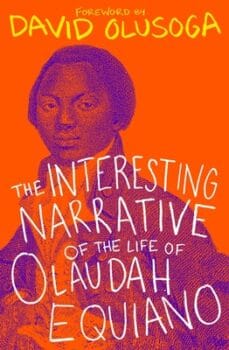
Kidnapped and sold into slavery at the age of ten, Olaudah Equiano’s memoir caused a sensation when it was first published in 1789. The Interesting Narrative of the Life of Olaudah Equiano is the true story of his life, from his ten years of service as a slave in the British Navy to his experiences – after having purchased his freedom twice – as a freed black man living in eighteenth-century England. Equiano would go on to be a leading figure in the anti-slavery movement, boosted by the success of his memoir, which became a bestseller and went through nine editions in his lifetime.
This new edition of the landmark memoir features a foreword by historian and bestselling author David Olusoga (Black and British), bringing this long-overlooked classic back into the spotlight, and showing his importance, which has been too often neglected, for the story of the abolition of slavery in Britain.
I have this in my Goodreads ‘Want to Read’ collection because I’ve picked it up several times over the years when I’ve seen it on display in Waterstones and it’s been in my Kindle deal watch list for ages. Will I ever read it? On the one hand, it sounds really interesting as a first hand piece of history, but on the other, it was written in the 18th Century for a white upper-class audience so I expect it to be very dry and full of naval stories… so probably not unless I catch it on audio.
2. The Original Folk and Fairy Tales of the Brothers Grimm (1812) translated by Jack D. Zipes
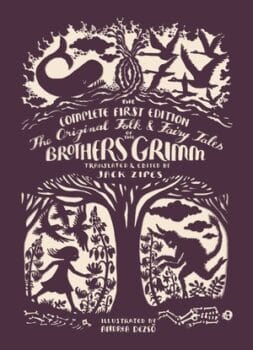
When Jacob and Wilhelm Grimm published their “Children’s and Household Tales” in 1812, followed by a second volume in 1815, they had no idea that such stories as “Rapunzel,” “Hansel and Gretel,” and “Cinderella” would become the most celebrated in the world. Yet few people today are familiar with the majority of tales from the two early volumes, since in the next four decades the Grimms would publish six other editions, each extensively revised in content and style. For the very first time, ” The Original Folk and Fairy Tales of the Brothers Grimm” makes available in English all 156 stories from the 1812 and 1815 editions. These narrative gems, newly translated and brought together in one beautiful book, are accompanied by sumptuous new illustrations from award-winning artist Andrea Dezso.
From “The Frog King” to “The Golden Key,” wondrous worlds unfold–heroes and heroines are rewarded, weaker animals triumph over the strong, and simple bumpkins prove themselves not so simple after all. Esteemed fairy tale scholar Jack Zipes offers accessible translations that retain the spare description and engaging storytelling style of the originals. Indeed, this is what makes the tales from the 1812 and 1815 editions unique–they reflect diverse voices, rooted in oral traditions, that are absent from the Grimms’ later, more embellished collections of tales. Zipes’s introduction gives important historical context, and the book includes the Grimms’ prefaces and notes.
I’ve had this book for years, I think I’ve moved house with it 4 times! I do want to read it but I’ve never been in the right mood. It’s such a lovely edition too.. maybe 2025 will be the year!
3. Northanger Abbey (1817) by Jane Austen
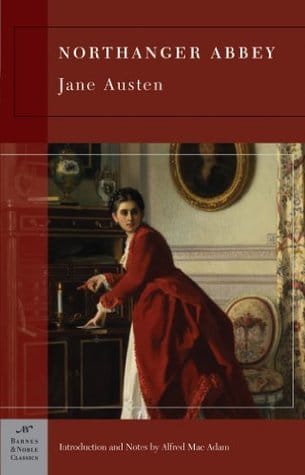
A wonderfully entertaining coming-of-age story, Northanger Abbey is often referred to as Jane Austen’s “Gothic parody.” Decrepit castles, locked rooms, mysterious chests, cryptic notes, and tyrannical fathers give the story an uncanny air, but one with a decidedly satirical twist.
The story’s unlikely heroine is Catherine Morland, a remarkably innocent seventeen-year-old woman from a country parsonage. While spending a few weeks in Bath with a family friend, Catherine meets and falls in love with Henry Tilney, who invites her to visit his family estate, Northanger Abbey. Once there, Catherine, a great reader of Gothic thrillers, lets the shadowy atmosphere of the old mansion fill her mind with terrible suspicions. What is the mystery surrounding the death of Henry’s mother? Is the family concealing a terrible secret within the elegant rooms of the Abbey? Can she trust Henry, or is he part of an evil conspiracy? Catherine finds dreadful portents in the most prosaic events, until Henry persuades her to see the peril in confusing life with art.
Executed with high-spirited gusto, Northanger Abbey is a lighthearted, yet unsentimental commentary on love and marriage.
After reading Persuasion (twice) in the last year I’m intrigued to read some more Austen. Probably on audio though, if I can find a production with a good narrator!
4. Anna Karenina (1878) by Leo Tolstoy
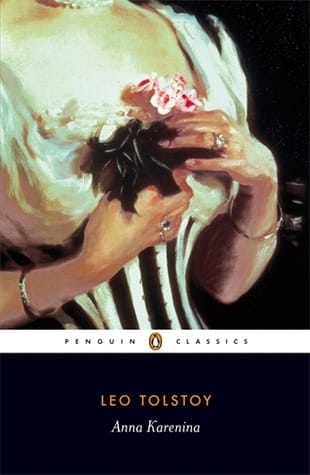
Acclaimed by many as the world’s greatest novel, Anna Karenina provides a vast panorama of contemporary life in Russia and of humanity in general. In it Tolstoy uses his intense imaginative insight to create some of the most memorable characters in all of literature. Anna is a sophisticated woman who abandons her empty existence as the wife of Karenin and turns to Count Vronsky to fulfil her passionate nature – with tragic consequences. Levin is a reflection of Tolstoy himself, often expressing the author’s own views and convictions.
Throughout, Tolstoy points no moral, merely inviting us not to judge but to watch. As Rosemary Edmonds comments, ‘He leaves the shifting patterns of the kaleidoscope to bring home the meaning of the brooding words following the title, ‘Vengeance is mine, and I will repay.
I also have Crime & Punishment by Dostoevsky (1866) on my list but I didn’t want two Russian novels I might never read taking up space, and I’m probably more likely to read this one… then again it is over 900s pages…
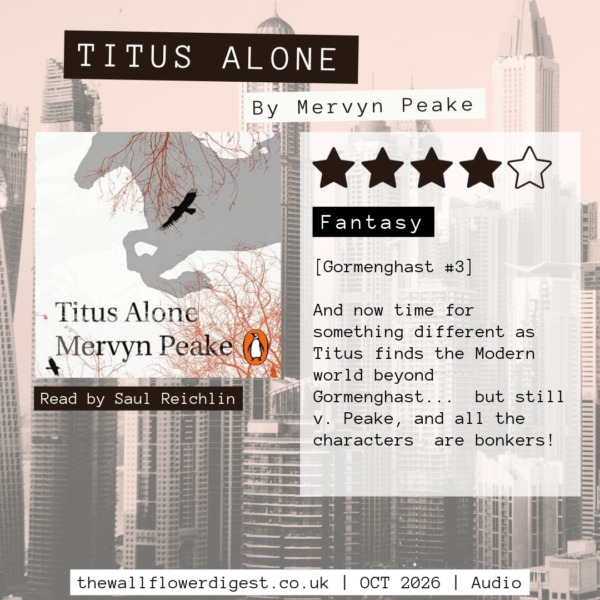
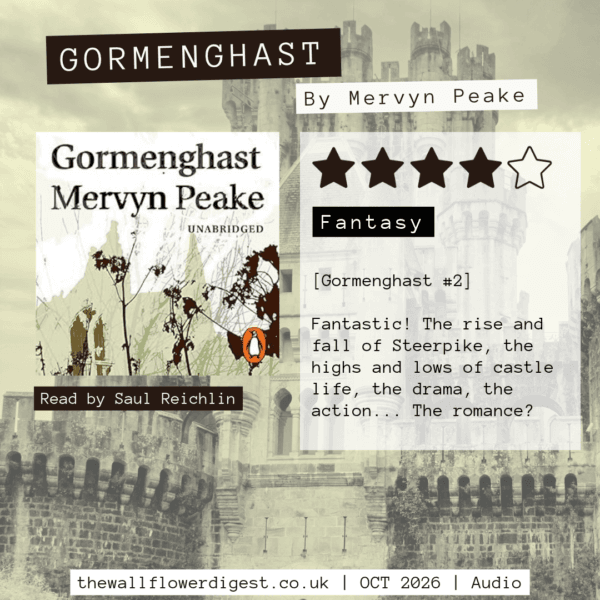
5. Titus Groan (Gormenghast #1) (1946) by Mervyn Peake
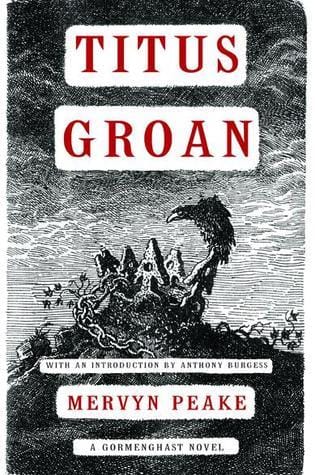
An undisputed classic of epic fantasy, Mervyn Peake’s Gormenghast novels represent one of the most brilliantly sustained flights of Gothic imagination, Titus Groan, the first book in this timeless series, is the start of an unforgettable journey.
As the novel opens, Titus has just been born. As heir to Lord Sepulchrave, he stands to inherit the miles of rambling stone and mortar that form Castle Gormenghast. Inside of Gormenghast, all events are predetermined by complex rituals, the origins of which are lost in time. Dreamlike and macabre, Titus Groan is one of the most astonishing and fantastic works in modern fiction.
This has been on my Want To Read list for a long old time! I heard about these novels on some BBC documentary with Sebastian Faulks talking about characters or some such, and it sounded cool. I have this on my Kindle, I just need to finally read it. I really don’t know if I’ll like it though, which is why I’ve hesitated for so long!
6. Cain’s Jawbone (1934) by Torquemada
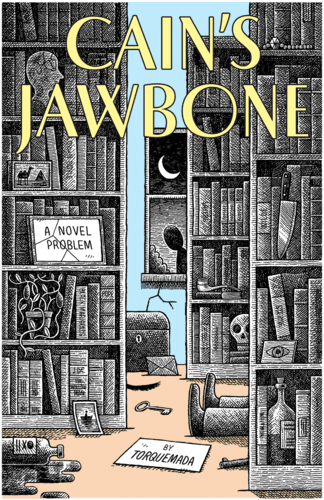
Six murders. One hundred pages. Millions of possible combinations… but only one is correct. Can you solve Torquemada’s murder mystery?
In 1934, the Observer’s cryptic crossword compiler, Edward Powys Mathers (aka Torquemada), released a novel that was simultaneously a murder mystery and the most fiendishly difficult literary puzzle ever written.
The pages have been printed in an entirely haphazard order, but it is possible – through logic and intelligent reading – to sort the pages into the only correct order, revealing six murder victims and their respective murderers.
Only two puzzlers have ever solved the mystery of Cain’s Jawbone: do you have what it takes to join their ranks?
Please note: this puzzle is extremely difficult and not for the faint-hearted.
So this one is more of a puzzle than novel! It did the rounds on the socials after someone solved it in 2020 during lockdown! My fiancé and I agreed one day we’ll try to solve it (to date only 4 people have solved it per the publisher’s competition! Only one of those after 1935!) but it’ll probably wait until we are retired! We do have a copy though.
7. Lolita (1955) by Vladimir Nabokov
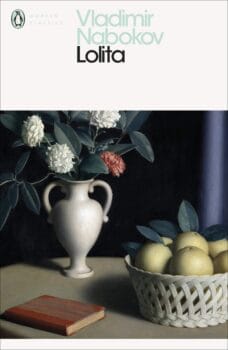
Humbert Humbert – scholar, aesthete and romantic – has fallen completely and utterly in love with Lolita Haze, his landlady’s gum-snapping, silky skinned twelve-year-old daughter. Reluctantly agreeing to marry Mrs Haze just to be close to Lolita, Humbert suffers greatly in the pursuit of romance; but when Lo herself starts looking for attention elsewhere, he will carry her off on a desperate cross-country misadventure, all in the name of Love. Hilarious, flamboyant, heart-breaking and full of ingenious word play, Lolita is an immaculate, unforgettable masterpiece of obsession, delusion and lust.
I’ve always been very wary of this book because of how wildly pop culture has misinterpreted it over the years, and how popular it is with groomers. I listened to the truly excellent Lolita Podcast that Jamie Loftus did a few years ago and learned that I really didn’t know what the novel really was (or that her real name is Dolores Haynes)! My main exposure to the story has been through the 1997 movie which I think I saw as a teenager too young to understand what was so gross about it. Anyway, that podcast is fucking great and it made me want to read this book. I have it on Kindle, I will get to it soon!
8. The Lion of Boaz-Jachin and Jachin-Boaz (1973) by Russell Hoban
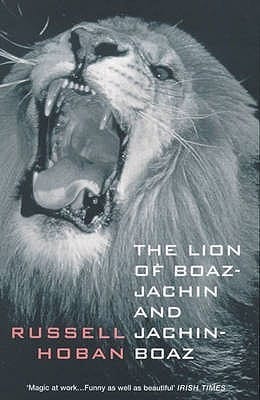
In a not-so-distant future when lions are extinct Jachin-Boaz, a middle-aged mapmaker, leaves home with a wonderful map that was to tell his son where to find everything. The angry son, Boaz-Jachin, goes to the ruins of a palace at Nineveh and performs a series of rituals before the wallcarving of a great lion dying on the spear of an ancient king. Called to life, the lion sets out on the father’s tracks and the son follows.
I am not entirely sure how this ended up on my “Want to Read” list but I think it was because Mona Awad mentioned it in an interview but I can’t find that interview now, I think it’s behind a paywall. It’s supposed to be super weird but thought-provoking magical realism. I am still interested to read it. I also have Turtle Diary by the same author from 1975 on my list which actually I just realised as way more Goodreads reviews!
9. The Infernal Desire Machines of Doctor Hoffman (1972) by Angela Carter
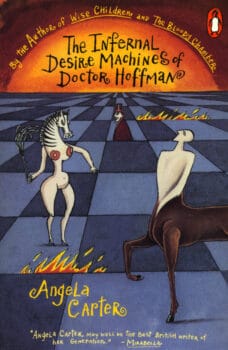
Desiderio, an employee of the city under a bizarre reality attack from Doctor Hoffman’s mysterious machines, has fallen in love with Albertina, the Doctor’s daughter. But Albertina, a beautiful woman made of glass, seems only to appear to him in his dreams. Meeting on his adventures a host of cannibals, centaurs and acrobats, Desiderio must battle against unreality and the warping of time and space to be with her, as the Doctor reduces Desiderio’s city to a chaotic state of emergency – one ridden with madness, crime and sexual excess.
A satirical tale of magic and sex, The Infernal Desire Machines of Doctor Hoffman is a dazzling quest for truth, love and identity.
I’ve mentioned my desire to get back and read some Angela Carter quite a bit recently and I really must fucking do it! I last read her in my 20s so I really don’t know what I’ll make of it now.
10. Woman on the Edge of Time (1976) by Marge Piercy
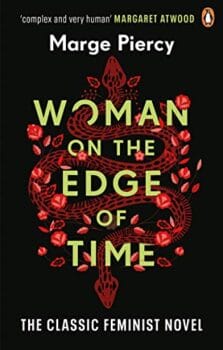
After being unjustly committed to a mental institution, Connie Ramos is contacted by an envoy from the year 2137, who shows her a utopian future of sexual and racial equality and environmental harmony.
But Connie also bears witness to another potential outcome: a dystopian society of grotesque exploitation. One will become our world. And Connie herself may strike the decisive blow…
It’s on my list because I’ve seen it on Waterstones displays and few times and thought it looked interesting, but with the modern cover I had no idea it was over 50 years old. Honestly, that does make me rethink reading it a bit as a feminist novel, but if I go into it knowing it was written in the 70s it could still be interesting! Plus it sounds like a good story!
That’s it, that’s 10! I really enjoyed this prompt. I spend more time looking at contemporary books these days so this was a good reminder of some older literature I’ve been interested in.
If you want a more recent and possibly more lively alternative to no.1, I can recommend The Secret Diaries of Chrales Ignatius Sancho by Paterson Joseph.
Great list! I haven’t read any of these before, but I want to read Northanger Abbey someday since I keep hearing others talk about it 🙂
If you’d like to visit, here’s my TTT: https://thebooklorefairy.blogspot.com/2024/11/top-ten-tuesday-oldest-books-on-my-tbr.html
Woman on the Edge of Time was excellent. Hope you like it!
Thanks Lydia, I am still interested to read it!
Great list, Jane Austen is a favorite and I like Brothers Grimm stories too.
Titus Groan and Cain’s Jawbone are in my shelves too.
I’m pretty sure I have read Lolita, but it would have be over two decades ago, which would also explain the vagueness of memory.
Hope you enjoy all these when you do find yourself in the mood to read them
I’d like to read Titus Groan too and also Lolita. Lolita has been on my TBR for such a long time.
I’ve heard of a few of these books, but have never had the desire to pick them up. With the Austen book, I think it’s because I tried to read one on my own and was instantly bored. The others are intimidating due to the size.
Pam @ Read! Bake! Create!
https://readbakecreate.com/oldest-books-on-my-tbr-ten-oldest-books-i-own/
I haven’t even heard of most of these! I hope you enjoy them when you get to them.
Happy TTT!
Susan
http://www.blogginboutbooks.com