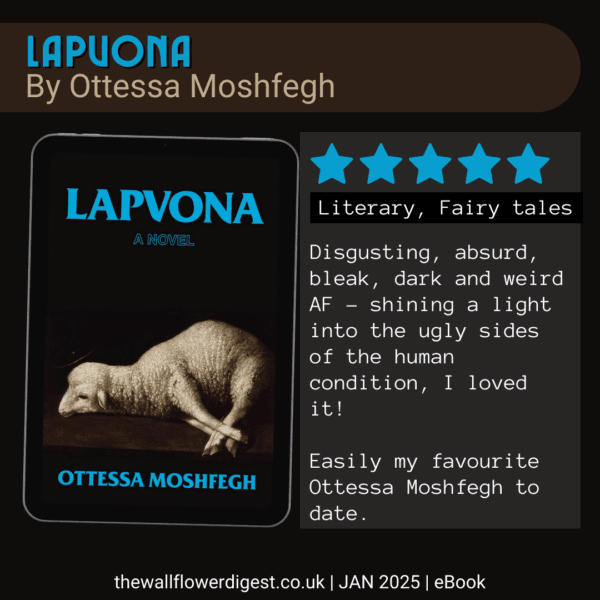
🐑🐑🐑🐑🐑 5/5 Sheep – Disgusting, absurd, bleak, dark and weird AF – I loved it!
Guys, I did it! After owning this ebook and putting it on TBR lists for years I finally fucking read it!! And, I loved it!
I hadn’t read any Ottessa Moshfegh in a couple of years and so I’d forgotten the biting, bleak, grimy thrill of her work! I’ve previously read My Year of Rest and Relaxation and Eileen, both I rated as 4 out of 5. The former I didn’t love as much as I wanted to but it tickled something in the dark corners of my brain. I preferred the latter, but it wasn’t quite tight enough to provide a wholly satisfying read. Unfortunately, I read both in the years I didn’t write reviews so my exact thoughts are lost to time!
How gross/disturbing is Lapvona?
Lapvona is now my favourite of the three, this one had the extra dose of weirdness and grotesquery that it turns out is a flavour I really enjoy! I didn’t realise this for long because so many reviews harp on about how disgusting and disturbing this book is, but honestly I don’t think it is that bad? Yes, there are lots of disturbing scenes (grown men nursing on an old lady, for example) but otherwise abuse, violence, cannibalism, rape, and implied paedophilia felt sadly unsurprising and even expected, given the brutal mediaeval world in which this is set. The style is sardonic and matter-of-fact, nothing gets lingered on. There are some gory descriptions but I found them more absurd than revolting.
Where you land on the “this is disgusting” scale will probably depend on what you read before! Having read, and loved, the work of Angela Carter (The Passion of New Eve left a lasting impression, don’t read that one with the flu!) and Martin Amis (especially Money) in my student days I have to say Lapvona wasn’t too eyebrow-raising!
Plot
Lapvona is the name of a fictional medieval fiefdom populated by staunchly religious peasant farmers who are ruled over by a supremely silly and selfish Lord Villiam, and the charlatan Father Barnabas who uses his sermons to control the villagers.
The story is told in a simplistic fairytale style, and on the surface is about the rise of a young mistreated peasant boy… But don’t expect to find any love or happiness! This was written by Ottessa Moshfegh!
I’ve seen some reviews complaining about a lack of plot, and that’s fair. Things just happen and it all feels quite random (as is often the case with fairy tales), but I liked that. It made sense with the darkly comic vibe, and how brutal life is in Lapvona. This is a novel more concerned with shining a light on how fucking horrible and selfish people can be, how religion can be a tool for the benefit of those in power and desperate people will cling to it to produce some reason for the troubles in their miserable lives.
Ugliness
Everyone in this story is awful… But in an interesting way! Ottessa Moshfegh is excellent at writing the ugly; she loves to magnify the selfish, the petty and all the dark feelings that make up being a human and in this, she goes more extreme than the previous books I’ve read.
The story hops around various POV characters but the main, at least at the beginning, is a thirteen-year-old Marek. Marek should perhaps be sympathetic due to his physical deformities (he’s short, hunchbacked with a twisted spine and misshapen, lopsided face) and his terrible abusive father, Jude. However Marek derives a perverse pleasure from his suffering, subscribing wholeheartedly to the doctrine that it brings you closer to God and heaven, and this gives him an attitude of pious superiority as he seeks both abuse and pity. Coupled with a simpering subservient manner, a tendency to jealousy, and a lack of intelligence and self-awareness, this overall combination makes him quite the impressively repulsive character in a novel full of horrible characters!
He lived for hardship. It gave him cause to prove himself superior to his mortal suffering.
Almost all the other characters are similarly narrow-minded and selfish. There is also his father, Jude, a brutish man who loves animals tenderly but is nothing but cruel to his own son and “his woman.” Jude has staunch black-and-white thinking and lacks self-awareness, just as Marek does. He regularly self-flagellates to atone for his sins, but Marek suspects he also finds pleasure in the pain. Father and son make quite the pair!
Ina, the elderly village witch and retired wet nurse is the only significant feminine presence in this book. She may appear on the surface to offer comfort and, with her abilities to community with nature, a different perspective but she has no warmth to her and is no better than the rest. She’s equally self-serving and opportunistic (even rude and ungrateful to the birds who aid her!), although given her treatment in her youth that’s easier to understand.
‘Then cook him for me. I’m hungry.’ She was serious. ‘And then I can nurse you, I’m sure.’ ‘What about heaven, Ina? Don’t you want to go?’ ‘It doesn’t matter,’ she said. ‘I won’t know anyone.’
Scarcity
The reason why the villagers in this book are so selfish, and that they cling to Father Barnabas preaching is because everything is scarce in Lapvona. There is not enough food or water, there is no education or leisure time, and there is precious little love or kindness. All the villagers do is toil in the field producing goods for Lord Villiam’s profit. They are always in survival mode which, as I learned from reading Daring Greatly, breeds a culture of judgment and shame, and leaves little room for compassion.
But secretly, Marek was a little pleased that he was bleeding and that surely the broken bucket would be reason enough for Jude to give him a sound beating when he got home. Pain was good, Marek felt. It brought him closer to his father’s love and pity.
Even when Marek receives unlikely good fortune, he’s so self-absorbed and uncritical that he never connects the contrast between the life the Lord leads or even conversations he hears with conditions in the village. He never has a single thought about helping anybody else. I thought the contrast of him eating a peach in blissful ignorance while visiting the starving village was fantastic.
The few times a character offers aid to another it always has an underlying motive of needing it expecting something in return. Or it’s to earn God’s favour, not for the sake of helping a fellow human.
Excess
While Lapvonians are starving to death their Lord Villiam is a spoiled, narcissistic and ridiculous man who eats and drinks endlessly. He has his servants constantly perform for him, he wants to be entertained every second of the day. The contrast between life at the castle and life in the village becomes more extreme, and an obvious allegory for our modern world, where the same things are happening on a larger scale.
The rise of Donald Trump and the egregiously transparent tactics used to get him into power are not that different to how Villiam and Father Barnabas manipulate the villagers. They tell them stories about bandits and ridiculous justifications for the drought, all while withholding lifesaving resources.
That was his primary function as the village priest: to listen to the confessions of the people down below and report any sagging dispositions or laziness to the man above. Terror and grief were good for morale, Villiam believed.
It’s no coincidence that sheep are the main livestock in Lapvona, and a sheep is on the cover of the book. The village definitely has a herd mentality, with Barnabas as their shepherd. But equally, Barnabas is afraid of the people realising he is a fraud, that he doesn’t actually know anything about religion, and then turning against him. This is why they keep them afraid and united against bandit attacks.
I loved it
I enjoy this dark, dry, weird humour when it’s done well. Ottessa Moshfegh has such a distinct style, she’s excellent at this bleak sardonic atmosphere. This one has lots of gore in it but I felt it was more grotesquely cartoonish (eyeballs flopping around, an old lady with horse eyes jammed in her sockets.. there is a lot of eye stuff…). I liked all the references to shit and blood, I could practically smell this book. There is something refreshing and hilarious to me about lamb shit being referenced so nonchalantly.
I’ve also been watching The Great recently which has a similarly brutal and revolting vibe! I fucking love it. Lord Villiam might actually be a little less volatile and violent than Emperor Peter in that show! Lapvona was also an interesting contrast to The Snow Song, both books having a fairy tale style and small village settings controlled by religious ignorance and scarcity.
Lapvona did encourage a little self-reflection on my own selfish tendencies, and the fact that humanity never changes.. we just invent new ways to fuck each other over.
I hovered for a while on whether this is a 4 or a 5 star read for me, and I decided to push it up to 5 stars/sheep because this weird fucked-up little book did light up my brain! I just would not recommend it to everyone!
If anyone has recommendations for more authors like Ottessa Moshfegh (or Mona Awad) I’d love to see them in the comments!
REVIEW SUMMARY
I LIKED
- Twisted, ugly, dark, and a little absurd! I enjoy the tone.
- I enjoyed all the horrible characters!
- The themes are topical and gave me some food for thought.
- It’s definitely memorable!
I DIDN’T LIKE
- Honestly, no notes!