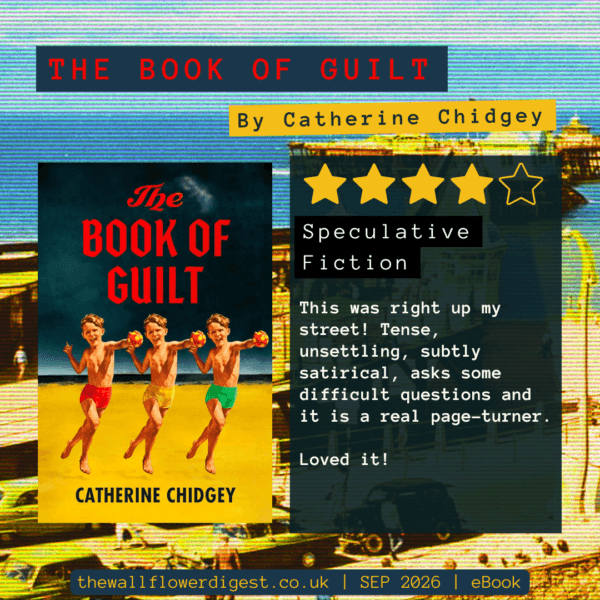
⭐⭐⭐⭐ 4/5 Stars – A speculative fiction page turner that was right up my street!
Format: eBook
Read: September 2026
I’d been looking forward to reading this for ages! I heard about it as one that Mona Awad recommended in an interview and was thrilled to find it on a 99p Kobo daily deal. Then I realised Catherine Chidgey is a New Zealand author, and so it made its way onto my reading list this year for Law of Fives- perfect!
The Book of Guilt is an alternate history speculative novel, set in Britain in the late 1970s. In this world, Adolf Hitler was assassinated on 16th November 1943 and, two weeks later, the Allies and Germany agreed to end the war, signing what is known as ‘the Gothenburg Treaty.’ This allowed for greater scientific collaboration between the Allied and Nazi scientists, which led to significant breakthroughs.
‘And then,’ she said, ‘with the collaborations made possible by the Treaty, huge progress was achieved. Our own Dr Roach made astounding progress in – in his field, with access to studies conducted in the camps before and during the war. Terrible information, some of it, but of immense scientific value. So you see, those poor people did not die in vain. They live on, in a way – we can think of it like that. We must keep in mind the greater good.’
One of these breakthroughs led to the establishment of The Sycamore Homes in 1943, which is where our thirteen-year-old narrator Vincent and his two twin brothers (William and Lawrence) live, though by 1979 they have seen better days, and the boys – and their three ‘Mothers’ – are the last remaining residents. Our other point of view is Nancy, a thirteen-year-old girl living a strange, isolated life with her creepy parents.
Catherine Chidgey really nailed the pacing in this; I found it such a page-turner! The mystery element – who are these children, what is this place? – I worked out the answers to those questions immediately (if you have read or seen the movie Never Let Me Go, it’ll be familiar), but that was no impairment to how much I enjoyed it. I think this worked because Vincent is telling us his own story from a later point in his life, but he is using his naive and childish point of view from that time. Vincent, the narrator, knows what thirteen-year-old Vincent doesn’t and of course it is only the Sycamore Children who do not know the truth. Everybody else in the world knows what they are. As a reader, I always felt ahead of the children, but I was invested in them discovering the truth and – crucially – what difference would it make? The real source of tension in this book is: how will the children react when they know the truth, and what will be done about it?
There is a pervasive atmospheric tension throughout the whole book that is subtle at first but really builds. In the beginning, it is just the sense that something is not right in Vincen’t strange life in this home. Adults are a constant danger to children; the Mothers are keeping secrets from them, ordinary people in the village treat them with open hostility, Nancy’s parents are creepy AF and won’t let her leave the house, and Margate is definitely too good to be true, right? It is even in the small throwaway interactions and comments in news reports, comments on a thirteen-year-old murder victim’s tight trousers and earrings, so she was practically asking for it. There are even casual historical mentions of Lord Mountbatten (his death at the hands of the IRA in 1979), and Nancy is a big fan of Jimmy Saville’s Jim’ll Fix It. Both, of course, we now know, were prolific paedophiles embedded in the British establishment who found victims in children’s homes.
I want to touch on the themes now, and I can’t do that without revealing who the Sycamore Children are!
So fair warning: past this point, Spoilers Ahoy!
🚨🚨🚨 HERE BE SPOILERS (Click to toggle) 🚨🚨🚨
I already mentioned Never Let Me Go by Kazuo Ishiguro; if you are at all familiar with that, you will work out what is going on right away! The basic plot is very similar, and I’ve seen some reviewers say they found it too derivative, but I didn’t have that problem because I think Catherine Chidgey has written something different and explores different themes. I also personally didn’t enjoy Never Let Me Go all that much – three stars; I found it too slow and sad – whereas The Book of Guilt I could hardly put down!
The children in the Sycamore Homes programme are clones, created by Dr Roach. They are used as human test subjects for the development of medical treatments, the aim being to cure life-threatening childhood diseases. This is seen as ethically sound because, as clones, they don’t have souls and therefore are not real humans. The first and second generation clones were created from the genetic material of stillborn children, but when the public found out, they had to stop that, and so the third generation (which includes Vincent) was created from prisoners, many of them violent offenders.
While Dr Roach may have started out intending to cure the sick, by the third generation he seems to be much more interested in eugenics and specifically the potential genetic origins of evil. Nature versus nurture is a huge question that hangs over this book; ultimately, this is the reason for the Book of Dreams and the Book of Guilt and why their lessons have a big focus on ethics. There is the idea of a genetic memory that the clones inherit from their donor, and it often manifests in dreams. These are reported every morning, while all incidents of misbehaviour are recorded in The Book of Guilt. If any disturbing patterns emerge in either, then the child and all their copies are sent to “Margate.”
Vincent and his brothers were cloned from a brutally violent serial rapist and murderer. Lawrence is a very sweet-natured boy who loves animals and dreams of being a vet. William, on the other hand, is impulsive and cruel, bullies his brothers, and his disturbing behaviour only escalates with opportunity. Vincent’s personality sits somewhere between his brothers. He is generally intelligent, charming, curious and kind, but he also has an enthralled love for William, and he covers up his bad behaviour, even when it is at great cost to his victims. On the other hand, he seems to often be irritated by Lawrence’s softness, which he sees as weakness. In his complicity, isn’t he just as bad as William? Our narrator, Vincent, doesn’t know the answer to this question.
Does that prove I am capable of great evil? Or of great sacrifice, great love?
The repeated justification for the existence of the Sycamore Homes is that it is “for the greater good” – they’re only clones, they’re not human, and so it is OK to torture children medically, and everyone is cool with it as long as it is out of sight, out of mind. There are other ways that the technology has been used illegally, and Nancy is one of those. There was another Nancy before, the real Nancy. She disappeared when she was a teenager in the 1960s, assumed to be a victim of the very man that Vincent and his brothers were cloned from. Unable to cope with the loss, her parents paid for an illegal clone from one of Nancy’s real baby teeth and brought up a new version. This new Nancy is not the same as the old Nancy; she doesn’t like beans for one thing, despite her parents insisting they are her favourite food and having to eat them constantly.
That storyline is disturbing – definitely not a healthy way to process grief! Even more disturbing are the other possibilities that are not explicitly said within the text but I think are absolutely there, between the lines. If Nancy’s parents were able to get hold of an illegal clone of their child, what would men with the resources of Jimmy Saville and Lord Mountbatten be doing? Dr Roach, who had also cloned and replaced his own dog because the original one was getting a bit old and infirm, seemed happy to take funding from anywhere to further his research.
I’m really impressed by this book; it’s great stuff – entertaining to read, and there is also a dry, subtly satirical humour that I enjoyed! I’ll definitely be looking out for more by Catherine Chidgey. She’s got a good-sized back catalogue for me to explore!
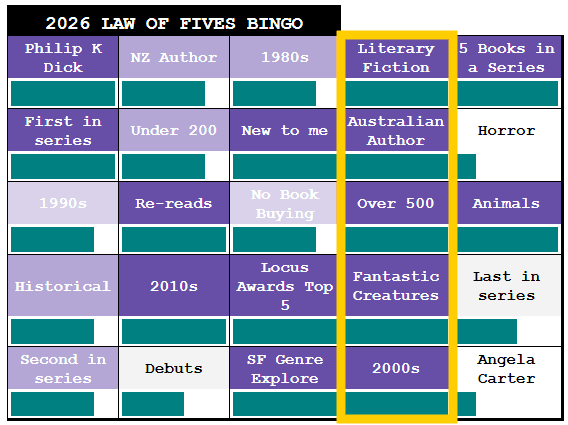
For Law of Fives, this makes for my 4th New Zealand author (all bangers!), and I’m counting it for my sci-fi genre exploration as a speculative alternate history.
REVIEW SUMMARY
I LIKED
- Tense and unsettling, subtly satirical.
- Well-paced, compulsive reading.
- Deeper themes pose tricky ethical questions.
I DIDN’T LIKE
- It is extremely reminiscent of Never Let Me Go, and that does take some shaking off at the start. (I preferred this to Never Let Me Go)