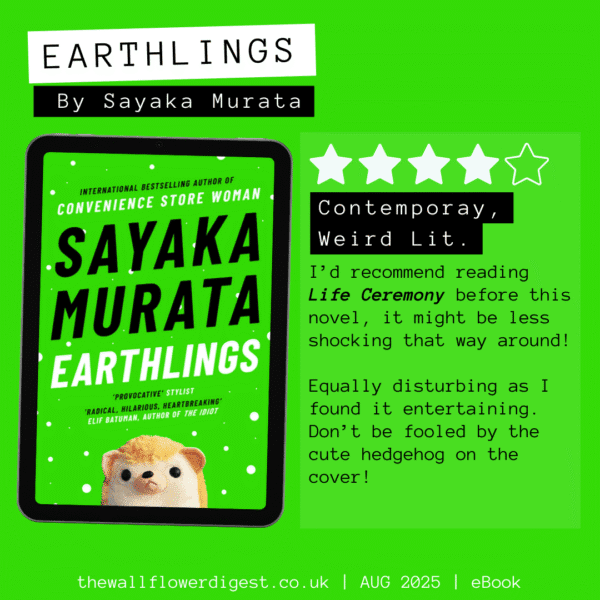
⭐⭐⭐⭐ 4/5 Stars – As entertaining as it is disturbing!
Oh wow. This book.
It’s going to be a little difficult to talk about without spoilers! I will include a toggle spoiler section at the end of my review because I need to talk about the ending and what I think was happening!
In brief, Earthlings begins with Natsuki in her childhood, convinced that she has magical powers and is an alien from another world, and follows her into adulthood and an unconventional marriage where she has still not been able to assimilate the expectations of society – that is, to reproduce and create more workers for The Factory.
I have previously read Convenience Store Woman and very recently Life Ceremony, a short story collection, by the same author. I am very glad I read Life Ceremony before this one because I think it prepared me for some of the more shocking and dark elements of this story! They explore the same themes (societal norms around marriage, sex, reproduction) with very similar narrative styles and character voices. Convenience Store Woman is also definitely cut from the same cloth, but I remember that one (it has been a while!) feeling more grounded in reality, and not so graphic and dark!
In fact there are a couple of stories from that that are very similar to elements in this novel. Most obviously (and without major spoilers), the relationship between cousins when they meet annually at the family’s Obon celebration was so similar that I wondered if it was the same characters (the short story is Body Magic), but it definitely is not!
Don’t let the cute toy on the cover fool you, this book needs trigger warnings for everything – child abuse of all kinds, rape, incest and some fairly graphic violent scenes towards the end. The main character, Natsuki, had clearly created her alien delusions to help cope with the neglect and abuse she suffers at home with her family. This also marks her out as a vulnerable child for the abuse by a paedophilic teacher. The combination of all this leaves her frozen in the POV of a child, and even once she’s in her thirties, she still sounds young.
As an adult, she struggles against the pressure to produce a child. She refers to the pressure to marry, have children and be ‘normal’ as The Factory. The purpose of the Earthling is to produce more Earthlings. She found a husband who shares her views (in a very similar way as the couple in A Clean Marriage) and also believes her to be an alien. We never learn about his background to understand what drives his fast and enthusiastic acceptance (other than an evidently violent father), only that it is the only thing that holds back his suicide.
My husband was heterosexual, but he’d had to bathe together with his mother until the age of fifteen and simply couldn’t handle a real woman’s body. He did have sexual appetites but he could satisfy them with fiction and wanted to avoid seeing female flesh as much as possible. I never asked him for details, but from what he’d told me his father was extremely strict. If by getting married he could get them off his back, he would be grateful.
(page 85)
As a child, Natsuki had a strong attachment to her cousin Yuu, and the two would discuss being aliens. Yuu also had an unstable home life, and it’s remarked several times that his clearly unstable divorced mother treated him more like her husband than a son. As an adult, he’s more resigned to the inevitable pull of The Factory.
This story is set in contemporary Japan, and I have no first-hand experience of the particular pressures of Japanese society, but as a childfree (by choice) woman, there was still plenty that resonated with me in this story!
I often think about why I don’t want children. It’s a long list of reasons I don’t want to do it, the reasons why I ever would are short and motivated by guilt, because having a child is what I’m supposed to do as a human woman. For my family, for my country and for the human race I’m supposed to make more people to continue our family line, and to provide workers for the economy.
So why don’t I want to do that? While I don’t have any kind of trauma in my childhood (my family are very boring and normal), I’ve always felt like an outsider. I’ve never been close with anyone in my family, I never had close friends in school, friend groups always fluctuated (I don’t have any friends from school), certainly never a best friend, and I’ve never felt a part of any stable community. If I’ve never felt safe and included by my local community, why would I produce a child for them? Especially knowing I can’t rely on the kind of support I know I’d need.
Plus – equally important – I just don’t enjoy being around children! Never have, never will!
When I think about Natsuki, her husband and Yuu with their unsafe family environments, it makes complete sense to me why they’d all reject The Factory and not want to reproduce any more workers to be chewed up by it. We know the most about Natsuki, and that every time she tried to reach out for support, she was rejected, at first by her mother, and then by different friends she thought she could trust. Nobody in The Factory cared about her safety or well-being, only that she should “get over it” and act “normal.”
Her sister is also an interesting case. As a child, Kise was a reject. Described as unusually hairy and prone to violent tantrums, she was bullied and had no friends. At home, she’d use Natsuki as an emotional, and sometimes physical, punching bag in the same way their mother did. Yet she clung to the promise of a place in The Factory, and in adulthood found acceptance and belonging through it. She is The Factory’s most zealous proponent.
But then we can question the fact that all three of them have childhood trauma. If they had grown up feeling safe, with functional parents and without inappropriate relationships with the adults who were supposed to care for them, would they be “normal?” If Natsuki had a loving mother and her teacher hadn’t assaulted her, would she have grown up with a healthy relationship to her body, wanted sex, and maybe even children? Would her husband and Yuu? Yuu is the closest to succumbing to The Factory, and he does have some support in the form of his uncle… or is that just the brainwashing working?
I wish I had more time to figure out my thoughts on this one! It’s left me with a lot of questions I’d love to parse out, but work and life have been so busy, I’d never write this review if I waited to be able to do that! (Which is what has happened with my still-not-yet-written analysis and review of Mona Awad’s Rouge!)
And then the ending. Once we see how they choose to live as “aliens” away from society, it is very shocking and definitely not something to aspire to! Is that the result of how harsh and uncaring The Factory was? Their families put so much extreme (and violent) pressure on them without ever asking why they made the choices that they did, that the extreme ending feels inevitable.
Spoilers for the ending! (click the toggle)
The ending gets very confusing! They’re delirious with severe malnutrition and probably poisoning from what they have eaten. I don’t think they are literally taking cannibalistic bites out of each other! I think they are having sex. Before that, Natsuki speaks of feeling loved and safe for the first time in her life (essentially since she was a child and felt safe with Yuu), and alludes to an awakening of the sexual desire that has been absent since her teacher “killed” her body. Plus, they are all hanging out naked at this point and sleeping in a pile together under blankets for warmth; it seems natural. This also tallies with Natsuki saying that the men are both pregnant when they’re discovered with swollen bellies at the end, though obviously, I think the swollen bellies are a result of their starvation!
[end of spoilers!]
Overall, I thought this book was very disturbing, but I did enjoy it! I think I got more out of it, having read the short stories right before. I suspected it’d be more of a shock if you haven’t read them! That said, I think at this point, having read 3 books that explored the same themes in very similar ways, I need something else from this author. I do have her new book – Vanishing World – but it does some very similar again, so we’ll see.
REVIEW SUMMARY
I LIKED
- Themes that resonate with me, and it did cause me to ask myself some difficult questions.
- I like weird.
- I enjoy the author’s narrative style.
I DIDN’T LIKE
- I mean… it has all the horrible things. It’s very disturbing at times.