🍅🍅 2.5/5 fake tomatoes – It didn’t work for me.
Format: Audio (BorrowBox)
Read: November 2026
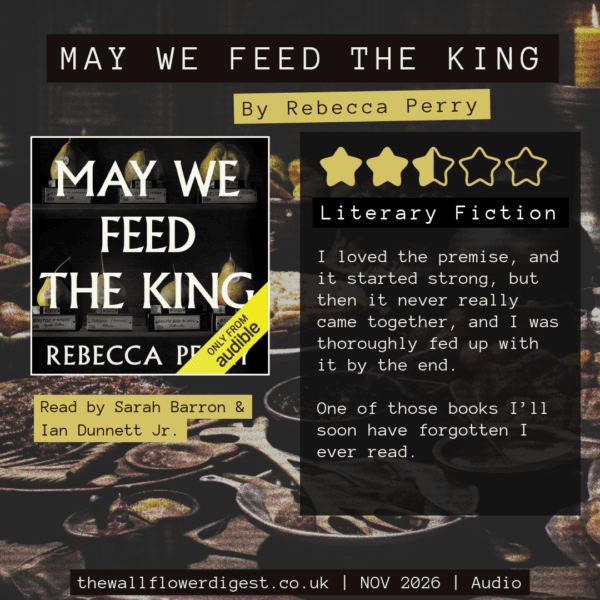
This one is another whim-pick found through scrolling BorrowBox. Apparently, it was shortlisted for the Booker Prize this year, and it was only 5 hours, so I thought it might be worth a go.
The premise also sounded somewhat similar to what I had wanted from The Everlasting, and that was a draw for me. I’m feeling lazy today, so here is the publisher’s blurb –
“A curator spends her days reconstructing the past–selecting and carefully arranging furniture, fabrics, and fragments of daily life to bring medieval rooms back to life. Whether it’s a feast with spilling platters or a table for two littered with small hints of intimacy: it must appear as if the people have just left the room. After accepting a commission to work on the private quarters of a medieval palace, the curator becomes absorbed in the story of a king almost forgotten by history. As she studies the traces he left behind, the boundary between her own life and his begins to blur”
It started off pretty strong. The Curator is an unusual character, evidently socially awkward and too intense when it comes to their job. However, it also seems they’re dealing with some sort of unprocessed trauma; it’s never explicit, but there is a subtext of grief over some kind of sudden loss. But then, just as it feels like things were getting going with The Curator, we jump perspective to that of the King, and that’s where it lost me.
While I like the intention to play with perspectives, gossip and rumours and how those inform the picture we have of History, and what we believe about famous figures, it lingers for far too long on the reluctance of the new King. The narrative became really repetitive about how ill-suited he was, and then just as I’m losing patience, it abruptly flew off into imagining all manner of gossipy sexual scenarios. Court gossip about the sexcapades of royals would have been rife, and perhaps this was intended to be a comment on how such rumours would spice up the banality of palace life (and such a boring, wet blanket of a king), but it just didn’t seem to sit well with me. I think there was also meant to be a parallel with implied gossip around the present-day Palace/museum over The Curator and The Archivist, however, I felt the ideas at play were too muddled and never cohered.
Despite this, I think it explores history as a construct with considerably more subtlety and effectiveness than The Everlasting (low bar, to be fair). That is, until the final chapter, when for some reason the author decided to include a literal lecture by The Curator to hammer home this message, in case the reader somehow didn’t get it. I don’t like it when writers assume I’m too stupid to understand subtext; it really undermined the endeavour, in my opinion.
I feel bad giving it 2 stars when I think technically it is much better than The Everlasting, or Yesteryear, it certainly has more literary merit, but ultimately it just didn’t work for me. It’s not that it is bad; it’s just not much of anything that resonated with me. I don’t think I’m going to remember ever reading it. I understand this is the debut novel for Rebecca Perry, who is otherwise a published poet; and I don’t seem to get along well with novels by poets.
Given the blurb about the blurring boundaries, I wonder if I completely missed something in my reading! It’s definitely possible; the audio format is not ideal. However, it didn’t spark enough for me to bother seeking it out in print. There are other books to move on to!
This would be another Debut novel for Law of Fives, and it’s both Literary and Historical.
REVIEW SUMMARY
I LIKED
- The Curator is an unusual character with an unusual job.
- Using a disorientating narrative and playing with points of view to explore history as a construction.
I DIDN’T LIKE
- Boring middle part where we get stuck with the reluctant king.
- Thematically, it never quite came together for me.
- The final chapter spells out the thematic message so literally that I felt it undermined the whole thing.
- It’s not memorable for good or for bad.