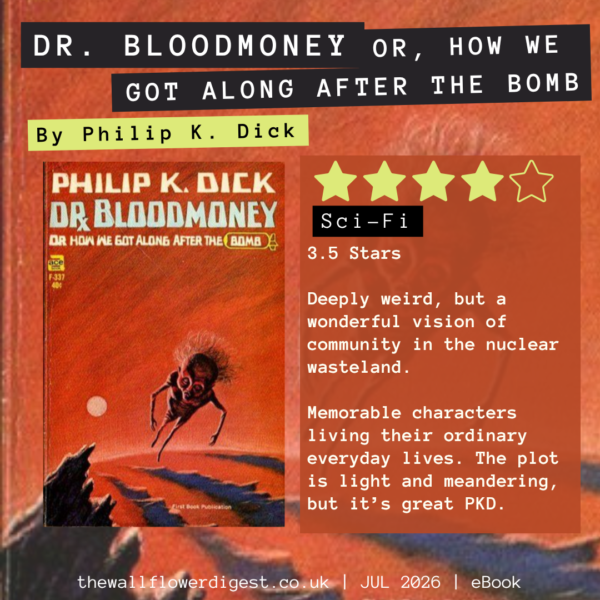
⭐⭐⭐ 3.5/5 Stars – Community in the nuclear wasteland: very, very weird with memorable characters.
Format: eBook
Read: July 2026
This is my second PKD book in a row, after I re-read (and re-loved) Do Androids Dream of Electric Sheep? and my first time reading Dr Bloodmoney. This one was published in 1965, so 3 years before Androids, and it is also concerned with the future of humanity after a seemingly inevitable war that will result in nuclear fallout.
Dr Bloodmoney is starts in the “future” of 1981, in Marin County, California. By 1972 there has already been an accidental nuclear event due to a miscalculation by Dr Bruno Bluthgeld while he was running some test, it doesn’t really matter what he was doing just that it happened, and the whole world (or at least North America) hates him for it because there is now a huge maount of radiation in the environment that has resulted in mutations, such babies born with phocomelia. As the novel starts, on a very ordinary day, Bluthgeld is seeking psychiatric treatment with Dr Stockstill, and some of our other characters – Stuart Conchie and Hoppy Harrington – are working in a nearby TV shop at the same strip mall. Walt and Lydia Dangerfield, a classically blonde American married couple, are being launched into space to start their journey as the first colonists on Mars. Then World War III starts with atomic bombs being dropped, and the narrative jumps forward to 1988, where North America is now truly a nuclear wasteland.
Now, most/all PKD books are weird (and that’s why I love ’em), but this one… this one is a new level (and btw, I am also obsessed with this book cover, the original one for the MM paperback)! Thanks to all this radiation, we’ve got talking animals, psychic powers and 9 year girl with her twin homunculus living inside her… who can also possess animals and talk to the dead. And yet, this is all so ordinary. I think the reason why PKD always resonates and fascinates me is that he’s interested in everyday, normal people who are just trying to survive and do their jobs amid whatever science-fiction craziness he’s dreamed up.
The main themes in this one are community and connection in this ruined, now sparsely populated world. Towns are now small, self-governing and fiercely protective of their way of life. They’re not morally opposed to a bit of capital punishment for any perceived threats. As long as it’s all “done properly”, in a civilised way, you know.
The sight still repelled Stuart, but there were so many repellent sights these days . . . it was one of many and certainly not the worst. What he objected to the most, he had decided, was the sight of symbiotics ambling along the street: several people fused together at some pert of their anatomy, sharing common organs. It was a sort of Bluthgeld elaboration of the old Siamese twins . . . but these were not limited to two. He had seen as many as six joined. And the fusions had occurred–not in the womb–but shortly afterward. It saved the lives of imperfects, those born lacking vital organs, requiring a symbiotic relationship in order to survive. One pancreas now served several people . . . it was a biological triumph.
Community in the nuclear wasteland
The old technology is largely destroyed. Girly calendars are “an art that has died out” because the women are now too scrawny, toothless and scarred from radiation to be objectified in the same way (what a shame!). There is no electricity, and cars are pulled by horses, yet old car batteries are hooked up to radios to listen to the broadcasts of Walt Dangerfield. Walt is now trapped up in orbit above Earth and acts as a disc jockey playing his extensive library of music and reading from his books. This is a hugely important community event that brings the scattered remnants of humanity together, and has everyone deeply invested in the health and wellbeing of Walt, especially when he begins complaining of being unwell.
Hoppy Harrington: Power and responsibility
Handymen, or Handys, are now the most highly valued members of society – so valued that a good one is worth considering “napping” – because they have the skills to keep the old technology running, including the radio. For the character Hoppy Harrington, this is a reversal in fortune, as in his previous life in 1981 people at best pitied him for his phocomelia (he was born with no limbs) and he has to get about on a wheeled platform (his ‘phocomobile ‘) and use arm extenders provided by the government. Though it is mentioned that others with phocomelia were the result of the radiation from Bluthgeld’s incident, it is stated that Hoppy’s condition is the result of his mother taking Thalidomide, an example of new technology in the real world that had devastating consequences for a generation of children. By 1988, thanks to his increased telekinetic powers, which he’s been able to use to upgrade his ‘mobile, Hoppy is the best Handy around.
The phoce flushed and stammered, “I was born in 1964; it had nothing to do with that blast.” As Stuart went out the door onto the sidewalk the phoce called after him anxiously, “It was that drug, that thalidomide. Everybody knows that.”
Hoppy is an interesting character. He actually reminded me of Marek from Lapvona, in that he should be sympathetic due to his situation in life, but his shitty, selfish attitude and ill-treatment of others stop him from being likeable. Hoppy is resentful of how he was treated before the war – which, maybe, is fair enough – but he’s also got an extremely peevish, childish personality that tends toward jealousy, and thereby he can never be satisfied. His power has gone to his head; the people of his small town are fearful of him, and I would describe Hoppy as the villain of this story because – unlike Bluthgeld – he is in touch with reality, and he does know what he is doing
Dr. Bluthgeld: Mental health and instability
Dr. Bluthgeld – the titular Dr Bloomoney in loose German – is the one considered responsible for at least the first nuclear event, and is possibly responsible for the others. He’s evidently very mentally ill; it’s not completely clear if he was more stable before the accident and it was perhaps guilt, shame and the hatred of everyone in the world that drove him mad or if he was always this way. Nevertheless, it appears he has lost touch with reality by 1981, when he is seeking treatment, and by 1988 he’s living a remote life – in secret – as a farmer outside the community.
At first I had sympathy for him, because (with the POV of his sympathetic colleague Bonny Keller) it sounds like the incident in 1972 was an accident, but then I thought more about it, and it actually was incredibly irresponsible for them to have been firing radiation into the atmosphere in the first place. They knew the radiation was dangerous, and scientific hubris was happy to put the planet at risk!
Many trained people, and the finest apparati, the foremost computers of the day, had been involved in the faulty calculation–not faulty in terms of the body of knowledge available in 1972 but faulty in relationship to the reality situation. The enormous masses of radioactive clouds had not drifted off but had been attracted by the Earth’s gravitational field, and had returned to the atmosphere; no one had been more surprised than the staff at Livermore. Now, of course, the Jamison-French Layer was more completely understood; even the popular magazines such as Time and US News could lucidly explain what had gone wrong and why. But this was nine years later.
The second round of atom bombs came about because of World War Three (a vague conflict between America and the Chinese, or maybe the Russians… it doesn’t actually matter). The planet is irradiated again, millions of lives destroyed, all because of the actions of a handful of men. The fact that in 2026 we still all live seconds away from nuclear weapons being fired (and many of the men currently in charge of the launch codes are not exactly stable, in an escalating political environment) is terrifying if you think about it.
This puts me in mind of our present moment, where we have AI LLM’s set loose and forced – against the will of all of us ‘small’ people – in every area of our lives with no regard for what this is going to do for our economic, social and mental wellbeing or our rapidly heating-up planet that is hurtling towards a water shortage. They’re also putting these AI models in charge of literal bombs. All so a small number of already very rich men can be even richer.
Anyway, back to Bluthgeld… while I had some sympathy for his mental health struggles initially, it becomes clear later on that he is very unstable, and he believes he has some kind of magic powers that bring about the bombs, and it appears like maybe he does, and the threat of a third round of nuclear disaster is real… but it’s left open to interpretation.
Mental health is also an issue for many of the characters in the story; nobody is really mentally healthy. Walt’s wife Lydia took an overdose of pills when she realised they’d never be rescued, and now he’s trapped in orbit alone and afraid of his failing health. Bonnie Keller – Bluthgeld’s old friend and colleague – compulsively has affairs with any new man in town, her husband seemingly oblivious, but her 9-year-old daughter Edie isn’t. The new teacher in town, Hal Barnes (Bonnie’s latest conquest), seems to be chronically anxious. Everyone has their struggles.
Stuart McConchie: Life goes on
I mean, he thought, I’m no better off now than I was before the goddam Emergency; I sold TV sets then and now I sell electronic vermin traps. What is the difference? One’s as bad as the other. I’m going downhill, in fact.
The most stable character is Stuart McConchie. His life doesn’t really change too much between 1981 when he’s working his job as a salesman in the TV store, and 1988, when he’s a travelling salesman selling traps for the mutant vermin. He’s still out there getting on, working through the perpetual struggle to make a better life for himself, and in that he’s a true Everyman character. He’s also notable for being the only character to see how unstable Bluthgeld is, even when he sees him in the street in 1981, and he’s proved right to have been unsettled by Hoppy’s strange powers too (he’d witnessed him doing a talk-to-the-dead-schtich to get free beer at lunch).
Stuart is African American and was something of a ‘diversity hire’ along with Hoppy at the TV store, since the story manager was keenly socially progressive. It’s worth noting his race seems to be more of an issue in 1988; it is called out as the main reason to distrust him as an outsider when he visits the town, which I think it’s safe to assume is populated by white folks. This was a book written in the 60s, so the word “negro” is used by other characters pejoratively to refer to him.
By the end of the book, Stuart takes tobacco and fine liquor entrepreneur Andrew Gill back to the city to see about upscaling his hand-rolled cigarette business with machinery (mass production of more poisons, but in the 1960s it might not have been seen as unhealthy as it is now!). These characters are hopeful for future prosperity, one where American Capitalism can be rebuilt.
“I don’t know exactly what to say to you, Bonny. I feel that we’re going to achieve a great deal here; I hope so, anyhow. Is it a base, onerous thing, coming here to arrange for new machinery for my factory? Is that–” He gestured. “Crass?”
“It’s lovely,” she answered.
I’m a confirmed Dickhead
I love reading Dick, and I love thinking about his work afterwards – making my mind maps in my notebook to figure out the themes – and reading other people’s thoughts on his work. This is only book 2 in my re-read probject and my excitement is increasing.
I love the way he writes; I love the unique stilted way that all his characters speak. They use language like they’re actors in an old movie, and they often express thoughts out loud to each other in a way that isn’t really natural, and yet somehow it makes them feel more real. They’re usually lonely and confused, like we all are, and just trying to get through the day past all this madness happening around us.
And yet, I debated awarding it 3 stars because my experience of reading through it was not exactly propulsive. I always had a good time while I was reading, but every time I put it down, I wasn’t eagerly motivated to pick it up again. I think this is because there isn’t really a lot of forward-motion plot. This is just everyday people going about their lives in an unremarkable way – despite the telekinesis, mutants, talking to the dead, homunculi, possession, talking dogs and whatnot.
However, I am going for 3.5 stars because I got very excited once I’d finished it, and I loved writing up my notes and writing up this review! So I would say it’s brilliant, and it’s memorable with a fantastic cast of characters, but go into it knowing what to expect. It’s not compulsive reading.
It reminded me a lot of I Cheerfully Refuse by Lief Enger, a novel from 2024 that I read last year and loved (4 stars). That is also a post-apocalyptic North America, interested in the future of humanity and how communities might survive, and a similar focus on the simple lives of everyday people. That book was brilliant, but it also meanders through its plot!
I am now moving on to Ubik, and very excited to re-read it now I’m much better at taking notes. I am determined to understand WTF is going on this time!
For Law of Fives, this is my second PKD read of the year.
REVIEW SUMMARY
I LIKED
- Memorable cast of characters.
- Focus on everyday lives of ordinary people.
- It’s weird, very weird.
I DIDN’T LIKE
- There isn’t a lot of forward motion in the plot.