
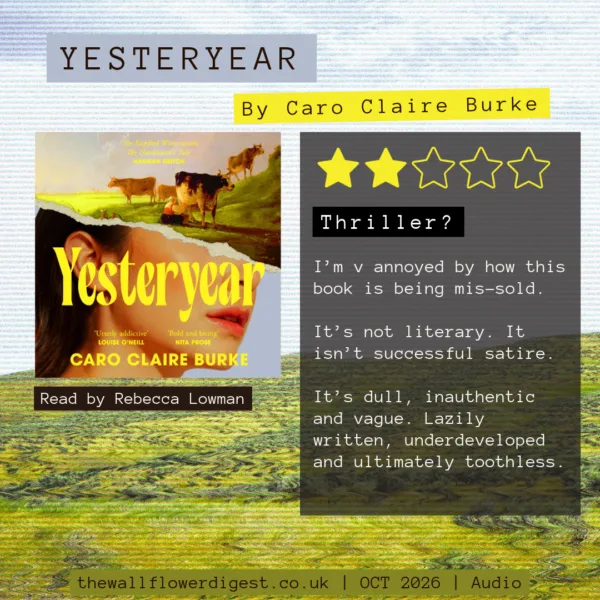
⭐⭐ 2/5 Stars – Woefully underdeveloped, and neither satire nor literary fiction.
Format: Audio (BorrowBox)
Read: October 2026
Unless you’re under a rock (or just don’t pay attention to recent releases), you’ll be at least aware of this book as one of the buzziest and most hyped of 2026. I’d heard many mixed things about it, which didn’t entirely put me off but pushed it down the list as one to only bother with if I could borrow it or get it for 99p. I ended up reading/listening to it because it was available when I came across it, looking for an audiobook to fill my time as I impatiently waited my turn with Catching Fire!
The premise – as told by the publisher on the back of the book – sounds tailor-made for me. I have had a fascination with American fundamentalist Christian influencers who push “traditional” ideology for years, and I love both satire and an unreliable narrator, and an unlikeable protagonist isn’t a problem for me… as long as it’s written well.
I shall start by stating that comparing Yesteryear to Kindred by Octavia E. Butler, or anything by Margaret Atwood, should be illegal. It’s nowhere near; it’s not even in the same genre. This is not well written enough to pass the bar as literary fiction, and it also doesn’t qualify as satire, in my opinion. It’s OK, I guess, as a beach read thriller if you go in with those expectations. It’s a mediocre airport book at best… which would be fine if it was being marketed as that!
This is not “high concept” or “biting satire” as Google’s stupid AI overview claims. Unless it’s so high concept that the satire is actually its very existence, how could it get a $2.5 million movie deal and be toted as some sort of masterpiece? If THIS is what qualifies as literary fiction with merit in 2026, then I think I am best off sticking with the classics.
I didn’t realise before I started the book that the author had 🚩 sold the movie rights before it was even finished. 🚩How is that even possible for a debut author?! (I suspect the answer is TikTok) I think this fact explains a lot; you can see where the Hollywood market may have removed all the real-world political elements required to make this work as an examination of the Tradwife phenomenon. I also wonder if having sold the rights to an unfinished book might have impacted the time the author had to finish this, because it is cripplingly underdeveloped and the ending is very rushed and full of gaping holes. It feels like it was written at the last minute.
Some people will defend all the inconsistencies, continuity issues and the fact that nothing really makes any fucking sense as a feature of the unreliable narrator’s mental state… but that is a complete cop out. The character is not well written enough for that to be the plausible intention of the author. The whole thing is sloppy and under-researched.
This piece is going to get long, despite trying to hold back! Like the scores of other reviewers and critics who had their expectations crushed by this mediocre thriller, I have a lot of thoughts to work through. I want to understand why this didn’t work! Where did all that delicious potential go?! And especially because this book is set in a movement I’ve been horrified by and seeking to understand for years, not least because it’s trying to infiltrate the politics of my own country.
You can’t have satire without specificity
There are a lot of problems with this book, but I think the best way to sum it up is that it lacks authenticity.
Topher at Topher’s Library summed this issue up well (in his very fair review) when he said that this book could be read by someone either supportive or critical of ‘traditional wives’ and they could finish it without having any of their opinions challenged. And this isn’t in the way of a cleverly intended plausible deniability; it’s just due to the poor writing.
Consequently, this does not qualify as satire, in my opinion! Satire requires specificity (I’ve been learning all about satire in the LRB Close Readings podcast series this year!). Satire understands its subject intimately, and only through that knowledge is it able to highlight and have fun with the absurdities.
Yesteryear fails because the author chose to tell the entire thing from the point of view of Natalie, and wrote her with one of the most bafflingly incoherent character voices I think I’ve ever read. There was no point that I believed she could be real, even as a caricature. I didn’t believe she was Christian. I didn’t believe any of the relationships, including Natalie as a mother.
I’m British; I’m an atheist, with my experience with Christianity being a light-touch Church of England Primary School (that boils down to hymns in Assembly and occasional talks from the vicar on special occasions)… And yet, somehow I came away feeling like I have a better understanding of the mindset of a religious person than the author does?! That shouldn’t be the case.
Natalie is written with the voice that one of the “judgemental women” in her comments section might think someone like her thinks. While claiming to be a Good Christian, she rarely thinks about God, never has moral conflicts, never for a second thinks about anybody other than herself, and never considers her moral standing. When she does mention God, it’s to apologise for calling someone a cunt, motherfucker or whore (“sorry God”). She also often takes the Lord’s name in vain, including “Jesus Christ.” And she’s like this the entire time, from the start of her story.
You might be thinking, well, surely this is just a satire of a hypocritical Christian? Someone posing that didn’t really believe? That doesn’t work because the author never builds a foundation for this character. If we don’t have any understanding of her religious beliefs and relationship with God, how can we judge where she is being hypocritical? Also, don’t forget that she went to flipping Harvard with a full scholarship to study theology! I won’t even get into how that piece of the story, and the circumstances of her marriage to Caleb, are nonsense! Others have done that better than I can.
Not only are the religious systems missing from this, but so are the politics. The Trad Wife trend, and the Quiverful movement (creating as many Good Christian voters as possible), that goes along with it, is the pretty face and ‘cosy’ nostalgic vibes disguising a convergence of sinister patriarchal and white supremacist ideology. Whether their church is LDS (like Ballerina Farm or the women of MomTok) or fundamentalist Christian (Kelly Havens, The Duggars (aka 19 Kids and Counting), Girl Defined, The Transformed Wife etc.), the systemic goal underneath any theological differences is always the same. It’s about men controlling women and keeping them at home, having a lot of babies – preferably white babies.
The thing is, I know that the author knows this because she has a whole podcast on these subjects, including an episode specifically on Ballerina Farm! I wouldn’t recommend that podcast, by the way. I listened to a few episodes out of curiosity, and the level of research and discussion is shallow and tired (I found both hosts quite grating); I actually came away from it with a worse view of the author. There are much, much better options created by people who actually have the experience to inform on what they are talking about!
Yesteryear only brushes against these subjects. Natalie’s Instagram account gets its first big boost when she was featured on the live stream of a popular Manosphere figure, someone Caleb is a fan of. This new audience is the gateway to finally starting to make money. Also, Father-in-law Doug is a state senator, and while we never get to learn anything about his policies (Natalie has no curiosity or interest), they definitely are right-wing. Later in the book, there is a rally that is described as having Nazi vibes, and he is very interested in access to Natalie’s audience to push his campaigns, but we don’t get more than that (Natale just dismisses it as political theatre; “it’s not real”). These critical topics aren’t questioned; they just get dropped into the background and left there. We don’t consider who it is that really benefits from pushing this lifestyle, or why it is so profitable and popular. I wonder if the Hollywood interference gutted this from the book, or if it is another symptom of laziness and/or lack of development?
I read Educated by Tara Westover earlier this year, and I felt frustrated by how conspicuously Tara also left these topics out of her memoir, but she did do a good job of explaining her old thought processes before and as she deconstructed her parents’ worldview. Funnily enough, she grew up in rural Idaho, the same state that Yesteryear Ranch is supposedly set in.
The other side of all of this is the Influencer angle. Performance is a dominant theme in this book; everybody is putting on a performance at the micro and macro level. From the gender roles to Natalie’s mother’s advice to pretend she is being watched as motivation when she’s struggling to cope as a new mother and wife, to practising how to smile in a mirror to her literal online audience. Examples of this are layered throughout, and I think it is successful at building this as a motif, even if it’s heavy-handed.
However, this is another area in which Natalie just didn’t make sense! I didn’t believe that she could be a hugely successful online personality. She is just so unlikeable – every character in this book describes her this way or avoids her! Her smile is inauthentic; she’s very prickly and sharp; she evidently has angry outbursts, and her own children stay out of her way. Her own mother says her problem is that she has never been nice. There is absolutely no warmth, and I don’t think you get a huge online following as a Tradwife, of all things, without having a natural “feminine” charm to draw people in. She isn’t even particularlly good looking! She has terrible social skills; there isn’t even any sign of the manipulative charm of a gifter. I am not aware of a single redeeming quality that would explain this!
The funny thing is, being an influencer and amassing a social media following IS something the author knows about, so you’d think she could have written at least this part with more confidence.
While the Tradwife element is clearly heavily inspired by Ballerina Farm, I can also see Ruby Franke (of ‘Mommy vlogger’ 8 Passengers, and then Devil in the Family, fame) in the mix, particularly with Natalie and Clementine’s relationship, and how things turn out in the ending. And also the randomly thrown-in lesbian accusations (I don’t have time to get into that!). I think this is probably why the author wrote Natalie’s personality so harshly, but like everything, it was too broad and heavy-handed.
A really great example of a book that successfully satires an Influencer (wellness, in this case) with an unreliable and unlikeable narrator was Idol by Louise O’Neill. That book does a fantastic job with a character who is both a victim and a villain, told from the same first-person point of view.
Two timelines, and they’re both boring
The narrative takes place in dual timelines. There is a present-day, past-tense narration telling the lead-up to the (usually) present-tense events of Natalie waking up in 1855. Answering this question of how/why Natalie is in 1855 is the only engine in the story, because there certainly isn’t any emotional investment with any of the characters.
Both timelines are boring. In the “present day” where we learn Natalie’s origins and how she came to be a trad wife, nothing remotely surprising happens, and in the past very little happens at all. She just has an orgasm for the first time, and she finally learns to like one of her children. There is a long stretch in the middle of this book that I found extremely dull, and I remember thinking if it wasn’t an audiobook I would have given up and skipped to the end to get it over with.
And then the last 10% of the book happens in a mad rush and blows plot holes in everything you just read. I’ve read other reviewers observe it has the feel of writing to a midnight deadline, and I completely agree!
The ending (spoilers, but I wouldn’t worry about it because this book isn’t worth your time)
Click here to show/hide discussion of the ending.
So it turns out Natalie is not in 1855 (by this point you won’t be surprised), it’s actually two years or so later, and this is her second batch of children. Apparently, instead of murdering Natalie following Shannon’s scandalous TV interview, her father-in-law decided to actually just let her and Caleb keep living on the farm and just remove all the modern conveniences and truly live the LARP like it’s the 19th century. And was also fine with them raising more of his grandkids in this environment. And I guess Natalie’s mother and sister, who don’t live far away (with the other kids who escaped), are also fine with this…
There are so many reasons why this is stupid and doesn’t make sense… it is almost an endless list.
Some issues, like the fact that Natalie is twenty years older and doesn’t notice that she’s now in a fifty-year-old body, or that she doesn’t recognise that her husband’s body, we could generously chalk up to her apparent memory issues/delusions.
Other things, more practical things, are just dumb as insulting to the reader. Are we saying that Caleb and Natalie, after spending huge sums of money renovating and already recently renovated house, decide to rip everything out? We’re talking electricity, plumbing, heating and, from the sound of things, insulation and double glazing? They did this without leaving any traces, and also made the house look older and more worn? (Though if this was 1855, wouldn’t everything look new?) The road also seems to have gone?! Then there is the sky… There would be planes and satellites, and light pollution surely!
Even if you ignore all of that, how the hell did Caleb go from shock and ‘my Dad wants to murder you’ to agreeing to this lunacy (which includes keeping her drugged for 15 years?!)? How come he was limp dicked and couldn’t fuck her earlier in the story (she got pregnant through sperm in a bowl and a turkey baster) and then suddenly in 1855-land he’s rock hard and raping her, and suddenly giving her orgasms?! There is a huge chunk missing here that is needed to make any of this make sense. Through the whole story, Caleb is a mess of a character; he changes depending on what the plot requires from him. What I think the author is going for is that this is because Natalie never actually sees him or knows him well enough (there are clues the poor guy is starved of intimacy, from the porn he watches to his affair with Shannon), but … again… the way this is actually written is not sophisticated enough to pull this off convincingly, so it came across as more sloppy writing.
We don’t get enough of him to be able to make a judgment: is he dumb as a bag of rocks or not? Was all this really Natalie’s idea, or had he steered her into it? Could they have been happy if he could have been a kindergarten teacher or a stay-at-home Dad, and she’d had her own purpose outside the home? Is he also a victim or a villain? There was potential here – but like everything else, it is left unfinished and too vague to be anything!
I don’t have a problem with the concept of this ending; I actually like it. The problem is the execution!
I’m so frustrated.
I got so wound up about this book because of how it is being misrepresented and mis-sold. It feels like there is a campaign to gaslight readers into thinking this book is clever. This depresses me and has me a little fearful for the quality of future books in this space. Because again – in my opinion – this book is neither literary fiction nor effective satire!
Then I remember there are contemporary writers out there who are actually excellent and genuinely write with a sharp bite (Mona Awad, Ottessa Moshfegh, Maud Ventura, Sayaka Murata); it’s just that they don’t get as much attention – or money – as this slop did! In the hands of somebody who cared about crafting an effective novel instead of an effective marketing campaign, this premise could be something stunning. There is a potential future classic in this subject, but it isn’t Yesteryear. Not the version that was published anyway.
What Caro Claire Burke is talented at is obviously spotting a lucrative trend, marketing and networking. She must have some friends in high places to have gotten that fat movie deal off the back of a draft of her debut novel. She just also happens to be an extraordinarily lazy writer.
Also, if you haven’t read Kindred by Octavia E. Butler, get right on that.
At least this got me a debut novel for Law of Fives!
REVIEW SUMMARY
I LIKED
- Premise.
- Performance as a layered theme… if heavy-handed.
- Almost got there with exploring how secular women are also trapped in patriarchal systems.
I DIDN’T LIKE
- Natalie never made sense or was believable in any facet.
- Narrative was completely uninterested in any of the other characters.
- Frustrating mix of heavy-handedness in the obvious or entirely too vague to make any point.
- Politics, religion and white supremacy conspicuously missing.
- Pacing is a mess; the ending is rushed and muddy.
- Misrepresented as satirical or as having any literary merit.
- A massive waste of a worthy premise.