

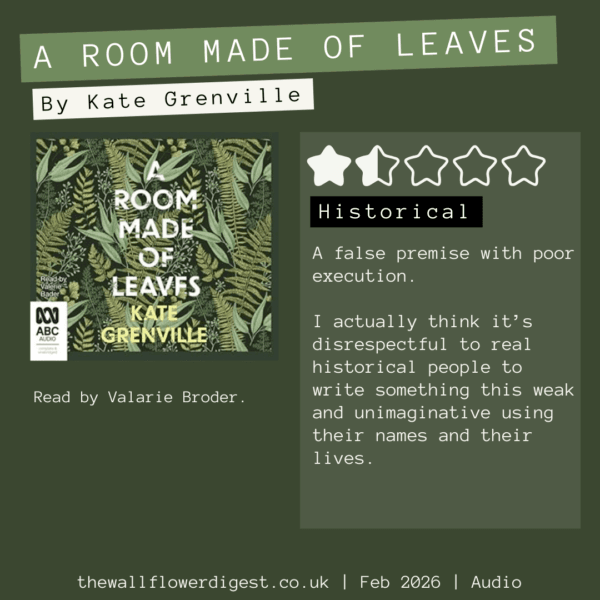
⭐⭐ 1.5/5 Stars – This does nothing remotely interesting and it pissed me off.
I am doing badly with Australian authors so far this year. I think I keep picking the bad books from otherwise well-regarded authors, which is more a case of luck of what my library has available than any design on my own part. First Nine Perfect Strangers (Liane Moriaty can do better), and now A Room Made of Leaves.
This book pissed me off.
I probably should have, and ordinarily would have, written it off as a DNF, but I wanted to get an Aussie author and a Historical novel ticked off, and it was an audiobook, so I could stick it on in the background. It pissed me off because it is not what it claims to be, and no, I don’t mean the irritating opening chapter that falsely claims what you are able to read are the real memoirs of Elizabeth Mcauthur that were found in a wall. They’re not, while Elizabeth Mcarther was a real person, but she did not leave any memoirs.
There are interviews with the author where she makes lofty literary claims about “false histories” and not to believe everything you read, even in historical records. Her inspiration for the book was the real and existing letters that Mcauthur wrote to her husband, John Mcarthur, while he was in England (during his multiple court martials). This is supposed to be the story she read between the lines of the stilted letters of a woman largely ignored by history. This is an interesting premise. Unfortunately, the execution does not live up to the promise.
The start of the novel spends far too long on the preamble of her early life and circumstances in England, when I think it would have been better to have started in Australia, where everything actually gets interesting. Instead, we open on territory so familiar I’d go so far as to call it trite: a young woman’s coming-of-age, learning about virginity and its value, the dangers men pose, and marriage as her only real option. None of this is badly written, but Grenville adds nothing new to it. We’ve read all of this before. She even throws in a mention of sexual exploration with her best friend, which again just feels like a check box from the ‘not like other girls’ list
The moment that threatens to actually get the plot moving – young Elizabeth willingly having sex with Mr McArthur behind a hedge, getting pregnant, and having to marry him – at least gestures toward something interesting. He’s older, scarred, and not particularly pleasant, but she enjoyed the power his pursuit gave her, even if she found it evaporated once his conquest was made. That’s a compelling dynamic and a harsh lesson for her to learn. But this just never goes anywhere; it’s left as nothing more than a rough sketch.
A ‘rough sketch’ is the bigger issue with Elizabeth herself. She has no real personality, and the personality she does display is oddly modern – she reads like a contemporary woman who has been dropped into the nineteenth century. She just doesn’t feel like someone shaped by her time and circumstances. The bits of character we do get, I found smug; there is a lot of self-congratulatory “cleverness”, and she often writes of how she works to manipulate and manoeuvre some of those around her, John included, but it’s honestly dull and unconvincing. It made me wonder whether the memoir conceit was the wrong choice entirely, particularly as Grenville doesn’t do anything with the idea of Elizabeth as her own unreliable narrator (so maybe she wasn’t as shrewd a manipulator as she writes, but then so what? The novel still doesn’t say anything about that). A more immediate first-person narrative might have drawn us closer to her. I wanted to be there with her, isolated in this alien land, literally oceans away from home, and experience her true thoughts and feelings in the moment.
There is, of course, also the John Mcarthur of it. Elizabeth gets the dubious honour of this book because of who her husband was. Women didn’t have choices back then, and they did spend a lot of time apart, so it is probably a safe assumption that he and his wife shared little fondness for each other; but, I also think that is too assume that (per historical records) he couldn’t have been a nice man, so his wife must have thought that too, and she couldn’t possibly have had any attraction to him. I felt no Truth in this portrait of their marriage. Whether they got along or not, whether she liked him or loathed him, whether she was ever scared of him, whether she was perfectly happy to profit from his behaviour… I wanted to feel it and be given a point of view I could try to understand.
The further through the book I got, the more I began to think that it feels genuinely disrespectful to real historical people to write something this thin and unimaginative using their names and their lives. The actual history of the McArthurs is fascinating and dark, and Grenville barely touches it. The early colony was brutal – for the first decade, people were on strict rations, some literally without clothing because supplies never came. My own life experience is so far removed from this that I can’t imagine living through it; it sounds terrifying. John McArthur was, by most accounts, a bully with grand ambitions, deeply involved in the corrupt, near-oligarchic military culture there, running illegal profiteering schemes. There were also constant conflicts with the native people whom the settlers had driven from their lands. Elizabeth was one of the very few women in the colony who went through nine pregnancies and raised seven children while it seems building and managing the wool business. How did we end up with such weak sauce?! Reading a Wikipedia summary of any of this is honestly more gripping than this book (Seriously, go and read about the History of Australia and John Mcarthur).
Instead of engaging with any meaningful Truth, Grenville invents a romantic connection between Elizabeth and William Dawes (another real person!) – the “room of leaves” of the title – and has her immediately sympathetic to Aboriginal people in a way that feels completely contrived. A real woman of that time and place would have had complicated, probably uncomfortable views, and Grenville’s refusal to go there feels like a cop-out. Again, it’s just disrespectful. A book published in 2020 should do better.
I was just so annoyed with this book because it never said anything. At every turn, Grenville wrote the most expected thing. There is a complete lack of imagination, and it just makes the whole exercise pointless. The audiobook narration also doesn’t help. Valaeri Brader’s performance is flat, and there are fluffed lines that were never edited out, which is a basic quality control issue. Maybe I would have liked this a little more if I’d read it on the page? I don’t know.
I have read in reviews that The Secret River is much better, but the experience of A Room Made of Leaves may have soured me on Kate Grenville!
I need to read 3 more Aussies this year… fingers crossed my luck changes and I stop picking up duds!
REVIEW SUMMARY
I LIKED
- Introduced me to a fascinating bit of history that I do not know anything about. I have had a good time on Wikipedia looking everyone up!
I DIDN’T LIKE
- The fictional memoir of a historical person conceit did not work at all for me.
- Does not deliver on its promise.
- A lack of imagination that also cops out on the difficult truths.
- Flat audiobook narration with quality control issues.

Ugh, this sounds awful!
A historical fiction filling in a story from the few facts known, that was done well, is The Sealwoman’s Gift. If you haven’t read that, I’d recommend it. Not an Australian author, though.
Some Australian authors you might want to look into:
– Trudi Canavan (fantasy; Age of Five series is her best but I enjoyed her others too)
– Kate Forsyth (fantasy; specifically her Witches of Eileanan series)
– Ian Irvine (fantasy; his series are linked so you’d want to start with the first one A View From the Mirror)
– Kate McIntosh (she started with fantasy but now writes historical fiction; I’ve only read her fantasy)
– Sara Douglass (fantasy; I believe many of her series and books are linked in some way too, so start with her first book; I haven’t read any of her books yet, but have heard she is good)
– Tony Shillitoe (fantasy; his series are also linked, though I read the last one first as it interested me the most and i’m now more interested in reading the earlier ones to find out the background to what what I already know)
– Jane Harper (mystery; The Lost Man is her best, but she has other good ones too – don’t start with The Survivors though as it is her weakest)
– Brooke Hardwick (mystery/thriller; her debut The Fog was great and I’m looking forward to seeing what she does next)
– Kate Morton (historical?; I haven’t read any of her books but have heard she is good)
There are probably some others I’m forgetting about. I’ve been rather slack with posting reviews in the last couple of years, but you could try the Australian author tag on my blog to see if there are any that interest you.