

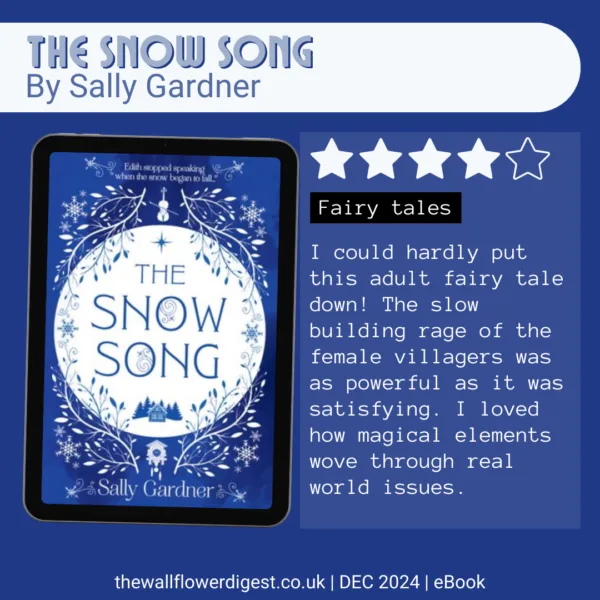
❄️❄️❄️❄️ 4/5 Snowflakes – The powerful adult fairy tale was an unexpected treat that I couldn’t put down!
Format: Kindle
Read: Dec 2024
Full disclosure, I was so into this book I ended up finishing it earlier than anticipated at 11pm on 31st December, meaning it should be in my 2024 reading review and my December round-up. This is what happens when I try to plan ahead!
I’ve been trying to remember if I’ve read anything by Sally Gardner before because I know her as a prolific children’s author. There are plenty of her titles I could name but haven’t read, the only one I definitely have is Tinder because was on the 2015 Carnegie shortlist in my School Librarian days. That one was an illustrated novel retelling Hans Christian Anderson’s The Tinder Box, I reviewed it on Goodreads and gave it three stars.
The Snow Song also reads like a fairy tale, though I don’t know if it is directly inspired by anything specific. The story begins with a young woman named Edith falling in love and quickly engaged to a handsome visiting shepherd. However her alcoholic father had promised her to the village butcher (and bully), and so an agreement is made that if the shepherd doesn’t return from grazing his sheep in the summer before the first snow then she will have to marry the butcher. Her shepherd never returns and in her grief, Edith’s hair turns bright white and she loses her voice.
The isolated folksy mountain village which is the setting for this story initially has a very vague sense of time and place. However, there are eventual mentions of home sewing machines and trains existing in the outside world which would place the time as at least the late 19th century, meaning this village is stuck in something of a time warp due to its isolation. As is so often the case, village life is run by a group of male elders who fiercely uphold patriarchal ideals. Women are only wives and mothers, and they must marry whoever their fathers and the elders agree for them and are essentially voiceless within their small society. There also are myriad traditions and superstitions enforced even when they fly in the face of sense and survival. All the female characters are miserable, even the ones who cling to tradition. Many of the men are faring no better, especially as everyone cows to the tyranny of the butcher.
At first, Edith finds there is power in not speaking. It unsettles everybody, especially the men, and encourages many villages to unburden their long-held secrets. The change they witness in Edith, and the clear injustice in her forced marriage to the old, repellent butcher, begins to make waves with the women folk. Eventually, Edith’s voice returns and she has new strength and power to stand up to the village elders.
It was interesting that most of the male characters are never named and only referred to by their lowercase professions – the cabinet maker, the butcher, the miller (and the miller’s son), the mayor etc. The shepherd and the butcher’s grandson were named, both of whom are treated as outsiders (Misha, assumed to be the village idiot), but I think that was it. Whereas the women all have names. I’m not sure what to make of this detail, on the one hand, I think it’s a part of the traditional story styling but I think it also demonstrates that the men are only their functional roles within society rather than individuals – even more sympathetic and enlightened ones, such as the blacksmith.
It is remarkable to me how compelling this book was! The style is that of a traditional fairy tale so it is very simply told and few words are spent on characterisation, yet Gardener deftly populates Edith’s life and the lives of her friends. The building rage of the other women, and a couple of men, in the village is slow at first but increases momentum towards a satisfying climax. I liked how well the story demonstrated the different ways that individuals in the village were affected by the behaviour of a few with too much power. It only took me 4 days to read this (384 pages) and it kept me up too late a couple of times! It’s been a while since that last happened.
My only minor criticism is that I was confused by what was going on in the mid-winter forest section. The magical realism got too blurry, a bit more fantastical than I was comfortable with in the story but honestly, that’s such a small quibble!
It also reminded me of All The Truth That’s In Me by Julie Berry which I read for the Carnegie 2014 shortlist and loved. That was less fairytale but was set in a remote traditional village and followed a young girl who had lost her voice. I hadn’t thought about that book in years, I found it quite powerful at the time.
Overall I recommend this, especially if you like adult fairy tale stories like Naomi Novik’s Uprooted or Spinning Silver. This one is written in a more traditional manner (and it does get very dark in its content) but it had me gripped, and I think it’s a rare and quite special read.
REVIEW SUMMARY
I LIKED
- A powerful, and quite dark, adult fairy tale that manages to be satisfying and compelling.
- Characters felt well-balanced and demonstrated a breadth of issues in such a harsh patriarchal society for both genders.
- Very atmospheric and I enjoyed the magical elements mixed in with very raw real-world issues.
- The slowly building rage of the female villagers was satisfying, as was the conclusion.
I DIDN’T LIKE
- Minor niggle is that I felt quite confused in the forest cabin bit!

I did the same with posting my celebrating series results thinking that the book I was reading would absolutely not be finished in the next three days, and it was. I forgot how much I can read when I am able to chill out with a book for a couple of days.
Thank you for your very thoughtful review . much appreciated. wishing you all the best Sally