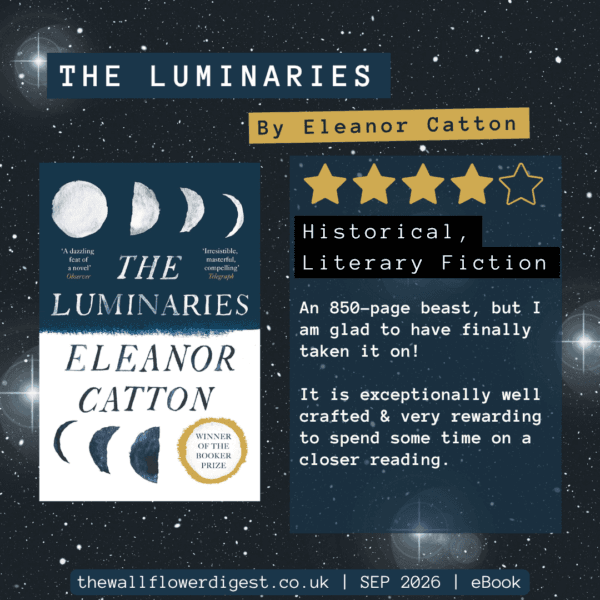
🔭🔭🔭🔭 4/5 Celestial Bodies – An impressive literary archivement, though it is very long!
Format: eBook
Read: September 2026
This 850-page-long Booker Prize-winning beast is one of those books that I knew required the right timing and circumstances for me to tackle it. Now having read it, I know that to be the truth, and to be thematically appropriate! If I had not had 4 beautiful holiday days in Majorca with nothing else to do (or think about) but sunbathing and reading, I would have really struggled to plough through it. Equally, if I hadn’t read it this year – my year of actively working on deeper, closer readings – even if I had finished it, I’m not sure if I would have been as open to looking past its surface-level story and appreciating it as a work of literature, because I do believe Eleanor Catton has done something very clever for those willing to look a little closer – and yes, I’m going to try for a thematic analogy – spot those specks of gold dust amongst the silt.
Though that isn’t to say that the story here is worthless, there is a juicy layered mystery story (set in the New Zealand gold rush), and it is compellingly told. However, as that concludes around the 600-page mark, there are 250 more to go; it starts to become apparent that maybe solving the mystery isn’t the whole point.
The information is all there before you dive into the first chapter. The waxing and waning moon is right on the cover art, and Catton provides a note to the reader and a character chart very explicitly linking them to the celestial bodies that they represent. However, if you are the same type of lazy general reader that I am (trying to be better!)… you probably blew past all that thinking, “eh, I look at this if I think it’s relevant“, and then forget all about it until you finish the book. (Also, in fairness to me, when I first started the book, I had been awake since 3 am to catch a flight!). So my advice to you, if you think you’re up for tackling The Luminaries and getting the most out of it, is to pay attention to this character chart as you start the book and try to keep it in mind! It turns out the author didn’t include it just because she thought it was cute!
The character/celestial chart provides the structure of the whole novel. Following the pattern of the waxing and waning of the moon, the chapters/parts start out extremely long but get progressively shorter by halves until the final chapters are only half a page. This does have the effect of making the first part of the book something of an endurance test (if, like me, you like to read a full chapter in a session!), but then the final part absolutely flies by in a frenzy.
Set in 1866, the style of the novel is authentically Victorian, and it is very stagey. We have an omniscient narrator (one who censors swears, like “d_ed”) who occasionally addresses the reader and a large cast of characters who are initially meeting to discuss a mystery and share their information through stories. The majority of the plot is moved through one character disclosing a new piece of information to others. This isn’t a style of novel that I typically enjoy so it took some pushing past at the start (if you read my other reviews, you’ll see “stagey” is usually a negative descriptor!).
I’m also usually a character-driven reader, and this is not a book that is very interested in its characters, but that is not to say that I didn’t find the characters to be effective! Catton has a Dickensian-like gift for capturing an archetype with sharp efficiency, and I never for a moment felt like anything was lacking; it’s just that deep introspection and emotional truths are not what we’re here for.
The characters are mostly white men with a defined role within the community (banker, newspaperman, politician, shipping agent, chemist, chaplain, etc.); it is a lot of Misters, but historically accurate, I guess! The more interesting ones include two Chinese men and a local Māori. There are three female characters in total: two at the centre of things. The opium addicted whore (in 19th-century parlance) found collapsed in the road and the estranged widow of the dead man, but to say much about either will give too much away.
I really enjoyed the setting and learning something about gold rushes and the communities that sprung up around them, the varied and colourful characters they must have attracted. I had never thought that there was a gold rush in New Zealand! This setting ties nicely with the celestial theme; there is something divine and romantic in it – this idea of striking it lucky, of finding a nugget amongst the dirt that will change your life. That seems like the kind of thing that would be written in the stars.
Celestial stories
In the end, I think it is about the telling of the stories. Every man arrives in this new town for the promise of striking it rich, to write a new story and shake off their old one. There are stories of crimes, conspiracies, love, betrayal, fortune, revenge, blackmail, maybe even a ghost… All the classics! Incredible coincidences start to feel more and more improbable; by the end some occurrences are downright supernatural.
Once I’d gotten into the rhythm of things, I realised I’d started to picture the book in my mind’s eye as a kind of stage. Each change in scene was a zoom up, then a zoom down to observe the next character, then pan back up to the sky; the globe turned backwards or forwards in time as we started to see how the past has influenced the present. We can start to draw lines between the choices and discoveries the characters make, and how their stories begin to intersect.
As I’ve said already, the pages go on after the natural conclusion of the plot as the moon wanes, and we wind all the way back to the start, even further than the start, filling in all the gaps with what we already have surmised by this point, but now we are on fast forward through the story of the ill-fated and naive young lovers – the sun and the moon – who were at the heart of things all along. It produced a really curious effect.
Once we finally spin to the end (which is also one of the beginnings), after 850 pages I was left to ponder everything I’d just read, and the time I’d put into it (4 days of intensive reading!). It felt like I’d read a lot of pages, but I’d not been particularly emotionally moved; I hadn’t been invested in the fates of any of the characters, and yet I had been interested as an impassive observer. I think this was because of the conscious narration and the position from above; the story has a sense of fated inevitability – all those past events and actions have already set the course; we’re just waiting for characters to catch up with each other.
As Kirsty Dunn wrote in her Guardian review, books of this length we expect to be profound in some way, or (if it’s a genre book) at least a big sweeping epic, and The Luminaries isn’t really either. Kirsty reads this as the author deliberately subverting the reader’s expectations, that in fact it’s about the idea of the novel. I think this is a really interesting reading, and I’m inclined to agree; I can see this in every choice that Catton made in this meticulously crafted work.
I’m very glad to have finally read this; I’ve found it really rewarding to engage with, and I am actually in awe of Eleanor Catton for so carefully constructing it and at 25 years old, no less. She’s the youngest person to win the Booker Prize at 28! If you have the time and patience for a big, chunky read, I do recommend it.
Maybe I’ll give a few more Booker winners a go.
For Law of Fives, Eleanor Catton makes my third Kiwi author, and this is another (well over) 500-page read, and it’s both historical and literary!
REVIEW SUMMARY
I LIKED
- Using the movements of celestial bodies in the night sky in 1866 to structure the novel is fiendishly clever, and it does produce an interesting effect!
- I enjoyed the historical setting – the New Zealand gold rush was interesting to learn more about.
- A Dickensian skill for capturing a character archetype!
- The central mystery – and the tangle of characters’ stories – was very satisfying and compelling to unravel.
- I found it rewarding to give it a closer reading; I’ve really enjoyed thinking and writing about it!
I DIDN’T LIKE
- It is very, very long! And it does take some getting going at the start.