
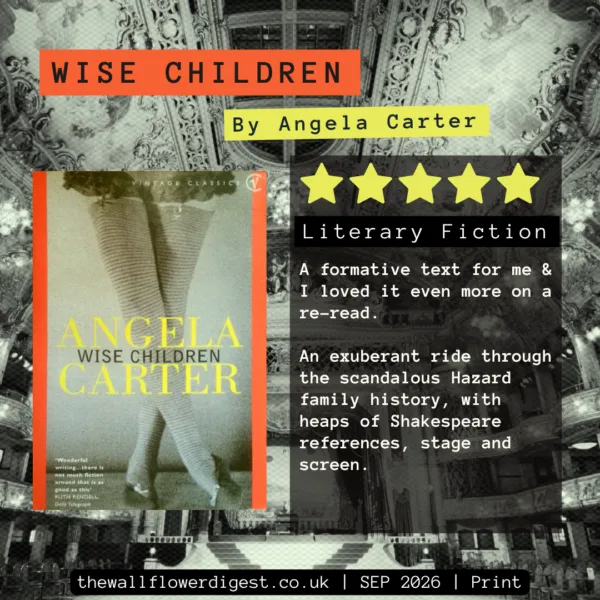
👯🏻👯🏻👯🏻👯🏻👯🏻 5/5 Twins – It left an impression on me at 17 & it’s just as fun 20 years later!
Format: Print
Read: September 2026
I first read Wise Children for my English Literature A Levels, and I have never forgotten it! It’s always been there in the back of my brain, especially the Chance family mantra: “hope for the best, expect the worst” (which I did take on as one of my own; I’m a natural anxious pessimist).
The other day we were in the car, and my husband had one of his Warhammer audiobooks on, and there was a character named Melchior; he wondered where the name came from, and I somehow knew it was one of the three wise men. I’m not religious; how did I just know that? It turned out it was thanks to this book – which has its own Melchior (following the stardom of this father)!
It was my introduction to Angela Carter; I instantly loved her, and she was the author I was keen to explore once I got out the other side of my English degree. I only got to read one of hers for Uni, The Passion of New Eve, which I think was for a gender module. I’ve also read The Magic Toy Shop and Nights At The Circus (soon to be re-read!), but it is still Wise Children that had the biggest impression (although there are some scenes from The Passion of New Eve that are scarred into my brain!).
It might be the most formative book in my literary life, the one that got me excited to pursue literature at uni, and I’ve been wanting to re-read it for years! Would it still resonate with me in the same way? How much of it do I really remember? The answer is yes, and I remembered a surprising amount given my generally poor memory for details!
“What a joy it is to dance and sing!”
Wise Children is a riot! It is a family history told from the point of view of Dora Chance leading up to her 75th birthday, and her absent, only sometimes-acknowledged father’s 100th. It takes the form of a memoir; Dora tells us she is bashing it out on an old typewriter in the attic room of their South London home. This isn’t any stuffy old sepia-toned wistful tale of an elderly woman in the twilight of her life, not at all – it’s bursting with energy and colour and DRAMA! Dora, and her twin Nora, aren’t old biddies – no, they’re those loud, cackling old women at the centre of the East End pub, fully made up (probably in furs) who will still give you a song or a dance whether you asked for it or not. They’ve lived more life than the average, and they’re not done yet!
Twins, opposites, and mistaken identities everywhere
This is a novel packed with themes, themes that are layered and intertwined so the whole thing is saturated. Dualities are there across everything, and Carter has a lot of fun taking Shakespeare and playing with all the tropes, tricks and absurdities in just about every way you can think of. I’ve already mentioned Dora and Nora are twins; they’re one of five sets of twins in the Chance/Hazard family. Each set of twins has a carefree, hedonistic (or just away with the fairies/goldfish!) personality and the other being serious-minded and focused. The Hazard family tree is a complete mess between all the twins and their assumed or actual paternity!
“It’s a wise child that knows its own father,’ hissed Peregrine, like the gypsy’s warning. ‘But wiser yet the father who knows his own child.’
At the top of the family tree sit Melchior and Peregrine Hazard, the twin sons of famous turn-of-the-century Shakespearean actors Ranulph and Estella Hazard. Melchior is also a serious Shakespearean stage actor, renowned for his incredible good looks and his ability to convey great gravitas. He’s a distant, cold and loveless character, despite his three marriages and six children. Peregrine on the other hand took after his mother with bright red hair and an irrepressiable larger than live warmth and sense of fun. He is full of joy and love yet never marries or settles down. It is Perry who ended up looking in on Dora and Nora as children; he becomes a part of their lives and their publicly acknowledged father, although everybody in the family knows they were really Melchior’s byblows.
High and lows
Contextually, this is a very British novel and more specifically London, as there is a geographical significance of Dora and Nora living south of the river in the poor East End while their father and his family live in the wealthy north (Regent’s Park, no less). The Thames is a wealth and cultural divide. The “high” culture of Shakespeare, theatre, and the stage versus the “low” music halls that the girls forge their careers in (and eventually nude shows once the music halls decline). Later, Melchoir is seduced by Hollywood, and they make a (pre-war) movie of A Midsummer Night’s Dream; Melchoir’s seriousness juxtaposes the tackiness of a cheap movie set fairy forest. The movie ends up a camp cult classic.
“We were destined, from birth, to be the lovely ephemera of the theatre, we’d rise and shine like birthday candles, the blow out.”
This idea that Shakespeare is somehow more worthy and cultured is poked fun at through this whole book. The Hazard family might be north of the River, and Melchoir’s first wife a titled Lady, but their family drama is more than worthy of Eastenders – despite the stiff upper lips! The plot is stuffed with references from the bard’s plays; everything is in here – mistaken identities, bed tricks, fools, farces, whimsy, sort of ghosts, dramatic secrets and timely reveals, and plenty of absurdity and magical realism. Dora tells it all with a knowing wink.
As she brings us up to date, things get more and more unlikely, and once we arrive at the evening of Melchoir’s birthday party it descends into full farce! It’s such a mad whirlwind of drama – unlikely characters entering and exiting the stage – by the time 75-year-old Dora is having it off with her 100-year-old Uncle, it’s like yeah… sure, why not! (Brave to decide to include this on the A Level syllabus! I had forgotten about that scene!).
“There’s more to fathering than fucking”
While this is a carnivalesque and frequently absurd story, that doesn’t mean there isn’t real emotion. Under everything is the pain of Dora and Nora being rejected by Melchoir and spending their whole lives on the sidelines of the great Hazard family. The way they are held there at arm’s length, the truth always unacknowledged, is a particular cruelty. Each encounter with him is painful, as he is incapable of ever giving them the love they crave.
“…a person isn’t flesh of its father’s flesh, is it? One little sperm out of millions swims up the cervix, and it is so very, very easy to forget how it has happened. And Melchior, whose flesh we were, or, rather, whose emission sparked off our being, felt for us only occasional pity and now and then a vague affection that seemed to puzzle him as to the cause.”
Dora’s reflections back on the woman who raised them, Grandma Chance, were also really poignant. Grandma was an enigmatic, formidable and larger-than-life woman well ahead of her time – feminist, vegan, nudist. Now past the age that she lived to, the twins can look back and understand her in a way they couldn’t as younger women. Dora is pained by memories of times they were cruel in their youthful ignorance and flouting of her principles as they brought home real fur coats from their lovers, or laughed at her wrinkled old nude body. That scene was physically painful to read; I could feel the shame as if it was my own.
What I find most striking about this book now, on my re-read, is just how viscerally exuberant it is. Dora comes right off the page; I am ready to hear and to believe her improbable stories – though I might be distracted by her mad make-up and her sparkly silver mini-skirt. I envy and am inspired by the energy of these women! I learned that Angela Carter was writing this book when she found out she had terminal lung cancer, and so I expect that motivated her to infuse this final novel with an infectious desire to live life to its fullest.
May we all live to be 75 (or 100!) and still have the energy to sneak off at a party for a bit of hows-your-father.
This book is a joy; I won’t wait 20 years to re-read it again!
For Law of Fives this is my first of five Angela Carter’s, and it’s also one for 1990s.
REVIEW SUMMARY
I LIKED
- Very funny, absurd and bursting with life!
- Thematically stuffed, and I loved the Shakespeare spoofs.
- Memorable larger than life characters and scenes that have stuck with me for decades.